
Practice Problems (KEY)#
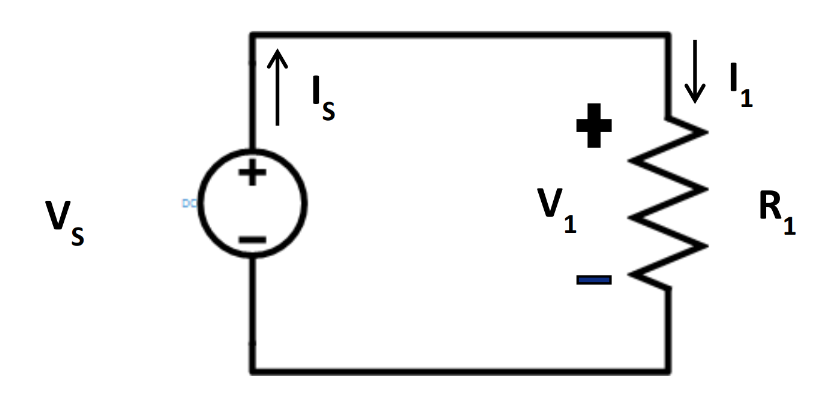
Variable |
Circuit #1 |
Circuit #2 |
Circuit #3 |
Circuit #4 |
|---|---|---|---|---|
\(R_1\) |
\(500\,\Omega\) |
\(13.3\,\Omega\) |
\(2\,\text{k}\Omega\) |
\(100\,\Omega\) |
\(I_1\) |
\(40\,\text{mA}\) |
\(600\,\text{mA}\) |
\(6\,\text{mA}\) |
\(200\,\text{mA}\) |
\(V_1\) |
\(20\,\text{V}\) |
\(8\,\text{V}\) |
\(12\,\text{V}\) |
\(20\,\text{V}\) |
\(P_1\) |
\(800\,\text{mW}\) |
\(4.8\,\text{W}\) |
\(72\,\text{mW}\) |
\(4\,\text{W}\) |
Variable |
Circuit #1 |
Circuit #2 |
Circuit #3 |
Circuit #4 |
|---|---|---|---|---|
\(R_1\) |
\(50\,\text{k}\Omega\) |
\(53.3\,\text{M}\Omega\) |
\(2\,\text{M}\Omega\) |
\(400\,\Omega\) |
\(I_1\) |
\(100\,\mu\text{A}\) |
\(15\,\text{nA}\) |
\(500\,\mu\text{A}\) |
\(150\,\text{mA}\) |
\(V_1\) |
\(5\,\text{V}\) |
\(800\,\text{mV}\) |
\(1\,\text{kV}\) |
\(60\,\text{V}\) |
\(P_1\) |
\(500\,\mu\text{W}\) |
\(12\,\text{nW}\) |
\(500\,\text{mW}\) |
\(9\,\text{W}\) |
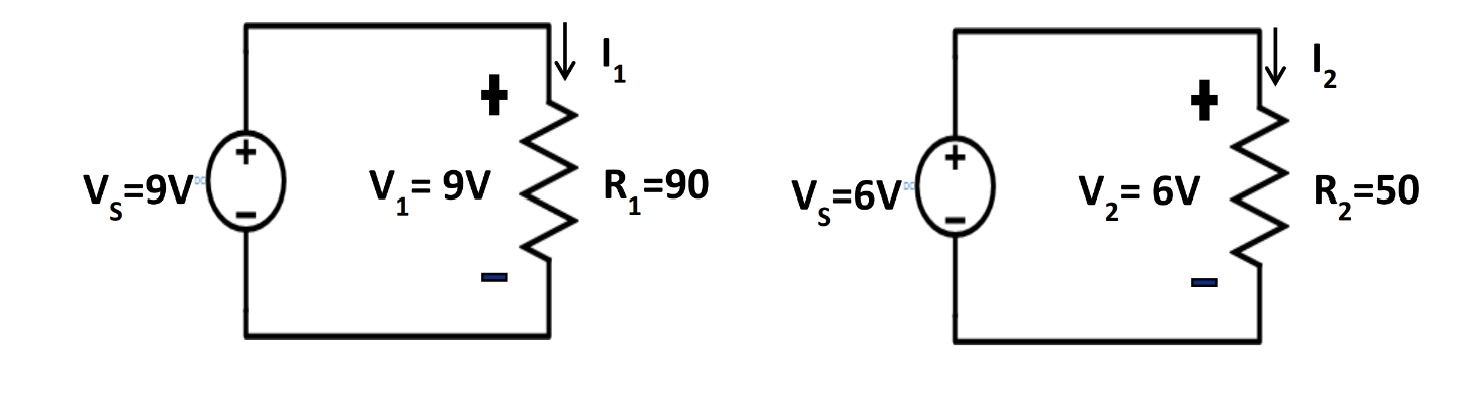
Option 1 |
Option 2 |
|---|---|
R1 = 90 Ω |
R1 = 50 Ω |
V1 = 9 V |
V1 = 6 V |
P1 = 900 mW |
P2 = 720 mW |
Design 2 is better because 720 mW < 900 mW.
The 100 W bulb draws more current: 909 mA > 455 mA.
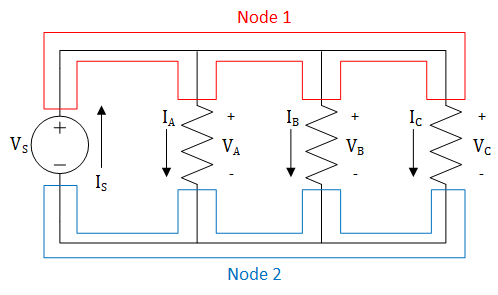
Variable |
Circuit #1 |
Circuit #2 |
Circuit #3 |
Circuit #4 |
Circuit #5 |
Circuit #6 |
|---|---|---|---|---|---|---|
\(R_1\) |
\(5.4\,\text{k}\Omega\) |
\(4.8\,\text{k}\Omega\) |
\(7.4\,\text{k}\Omega\) |
\(4.8\,\text{k}\Omega\) |
\(667\,\Omega\) |
\(1.125\,\text{k}\Omega\) |
\(I_1\) |
\(2\,\text{mA}\) |
\(5\,\text{mA}\) |
\(1.08\,\text{mA}\) |
1.04 mA |
\(15\,\text{mA}\) |
\(8\,\text{mA}\) |
\(V_1\) |
\(10.8\,\text{V}\) |
\(24\,\text{V}\) |
\(8\,\text{V}\) |
\(5\,\text{V}\) |
\(10\,\text{V}\) |
\(9\,\text{V}\) |
Circuit #4 is best because 1.04 mA is the smallest current.
Variable |
Circuit #1 |
Circuit #2 |
Circuit #3 |
Circuit #4 |
Circuit #5 |
Circuit #6 |
|---|---|---|---|---|---|---|
\(R_1\) |
\(100\,\Omega\) |
\(300\,\Omega\) |
\(8.2\,\text{k}\Omega\) |
\(4.8\,\text{k}\Omega\) |
\(1.5\,\text{k}\Omega\) |
\(1.2\,\text{k}\Omega\) |
\(I_1\) |
\(15\,\text{mA}\) |
\(8\,\text{mA}\) |
\(5\,\text{mA}\) |
\(12\,\text{mA}\) |
\(6\,\text{mA}\) |
\(10\,\text{mA}\) |
\(V_1\) |
\(1.5\,\text{V}\) |
\(2.4\,\text{V}\) |
\(41\,\text{V}\) |
\(57.6\,\text{V}\) |
\(9\,\text{V}\) |
\(12\,\text{V}\) |
\(P_1\) |
\(22.5\,\text{mW}\) |
19.2 mW |
\(205\,\text{mW}\) |
\(691.2\,\text{mW}\) |
\(54\,\text{mW}\) |
\(120\,\text{mW}\) |
Circuit #2 is best because its power consumption of 19.2 mW is the smallest.
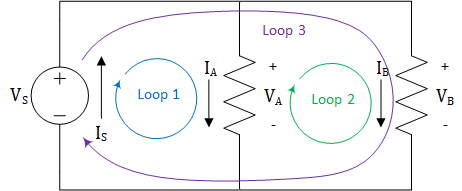
Resistance and current are inversely proportional, as shown by Ohm’s Law \(I = \frac{V}{R}\). Since voltage remains constant and resistance increases, current decreases.
If resistance doubles, current is halved.
Power is proportional to the square of voltage, as shown by \(P = \frac{V^2}{R}\). If voltage is halved, power is reduced by a factor of four.
Power decreases by a factor of 4 when voltage is halved.
(a) Would a 28 V battery be an acceptable voltage source?
Not acceptable.
Alternate method:
Not acceptable.
(b) What is the minimum allowable voltage for the voltage source?
(a) Is a current of 9.2 mA acceptable?
Yes, this is acceptable.
Alternate method:
Yes, this is acceptable.
(b) What is the maximum allowable current in the circuit?