
Lesson 25 Practice Problems#
An accelerometer used to measure the G loading on an aircraft outputs values between \(100\ \text{mV}\) and \(500\ \text{mV}\). We are interested in acceleration frequencies below \(4500\ \text{Hz}\).
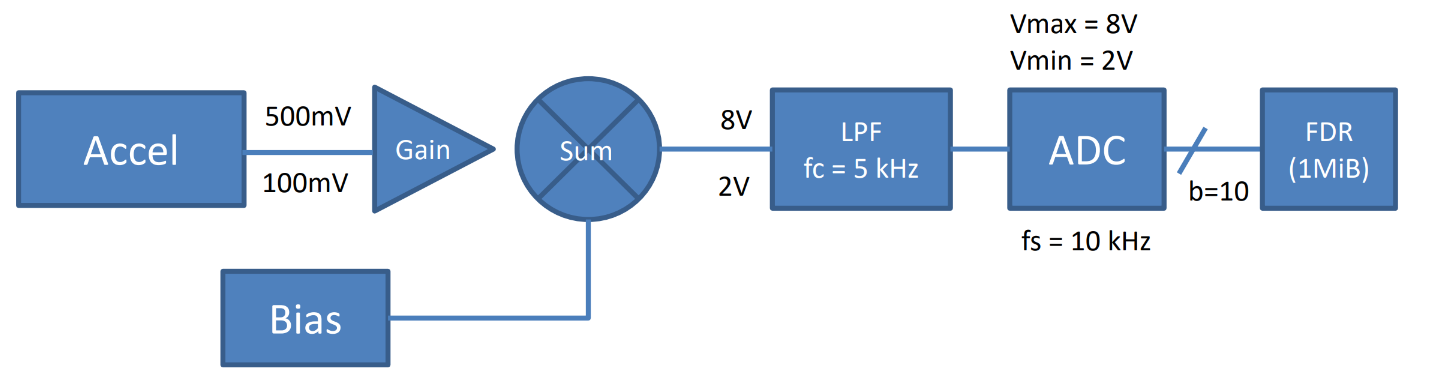
a. Determine the required gain, \(K\), and bias, \(B\), for proper signal conditioning.
b. Can the accelerometer be used directly with the given ADC? Justify your answer.
c. Does the ADC meet the Nyquist rate requirement?
d. If \(v_{in}(t) = 400\ \text{mV}\), what will the digital output of the ADC be?
e. What is the bit rate into the flight data recorder?
f. How long will it take the flight data recorder (FDR) to fill? (Assume \(8\ \text{bits} = 1\ \text{Byte}\).)
How can a low-pass filter (LPF) be used to prevent aliasing?
What must the cutoff frequency, \(f_c\), satisfy relative to the sampling frequency, \(f_s\)?
T / F: An ADC’s maximum quantization error cannot be greater than its resolution.
The following ADC is to be used to convert a music signal into a digital output:
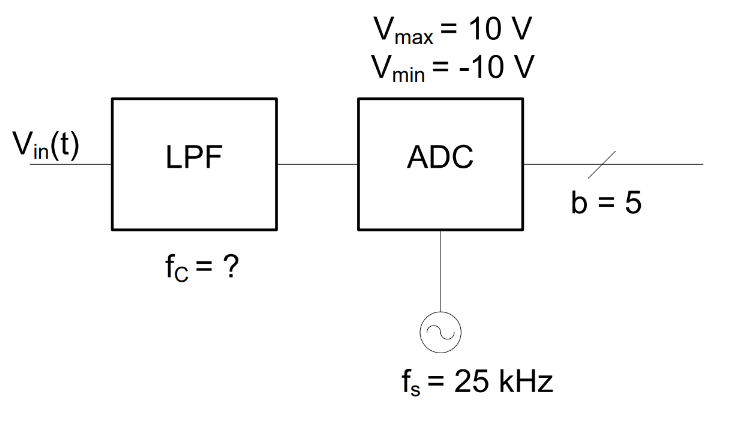
a. To prevent aliasing, what must the highest frequency of the input signal be limited to by the low-pass filter?
b. What is the resolution of this ADC?
c. What is the digital bandwidth of this system (i.e., how many bits per second does the ADC output)?
Given the two analog-to-digital converters below, answer the following questions and justify your answers.

a. Determine the resolution for each ADC.
ADC A: ____________________________ ADC B: ____________________________
b. Which ADC has the better (smaller) resolution? A / B
c. Which ADC will take more samples in 10 seconds? A / B
d. If connected to a \(2\ \text{Gbit}\) thumb drive, which ADC will fill it faster? A / B
An accelerometer is used to measure the G loading on an aircraft. It generates a \(+20\ \text{mV}\) signal at \(+8\ \text{G}\) and a \(-10\ \text{mV}\) signal at \(-2\ \text{G}\). This signal must be conditioned before entering the ADC shown below. The conditioning must also prevent aliasing.
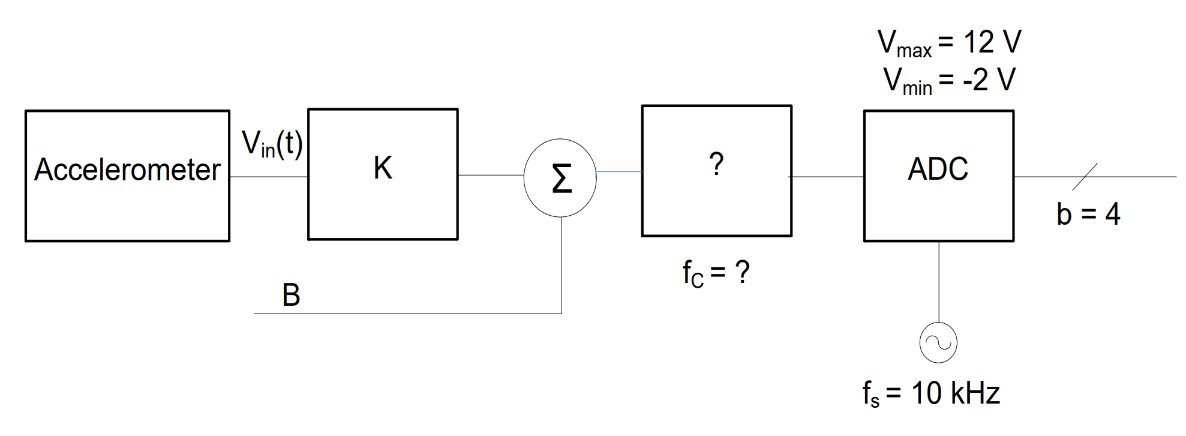
a. Design a transducer interface (gain \(K\) and bias \(B\)) to map the accelerometer output across the full ADC dynamic range.
b. What is the resolution of this ADC?
An accelerometer signal is amplified with a gain of \(1000\), filtered to prevent aliasing, and then digitized using the system below.
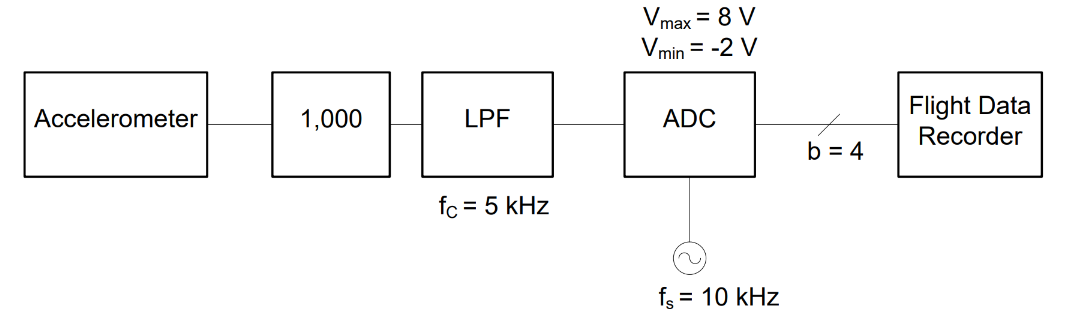
a. If the flight data recorder has a storage capacity of \(275\ \text{MB}\), how long can it record data?
Convert storage to bits and determine recording time.