
Lesson 30 – Demodulation#
Learning Outcomes
Compute transmitter power efficiency for an AM system with a given modulation index.
Describe block diagram AM demodulators and their limitations.
Analyze envelope detectors in the time domain and synchronous detectors in the frequency domain.
Given an AM modulated signal, design an AM demodulator to recover the original message.
Explain the engineering trade-offs between over- and under-modulated AM communication scenarios.
Design a band-pass filter (HPF + LPF in series) that selects one station from a frequency-division multiplexed signal.
Demodulation#
The last several lessons have focused on modulation. This lesson focuses on demodulating signals to recover the original information and understanding the associated trade-offs.
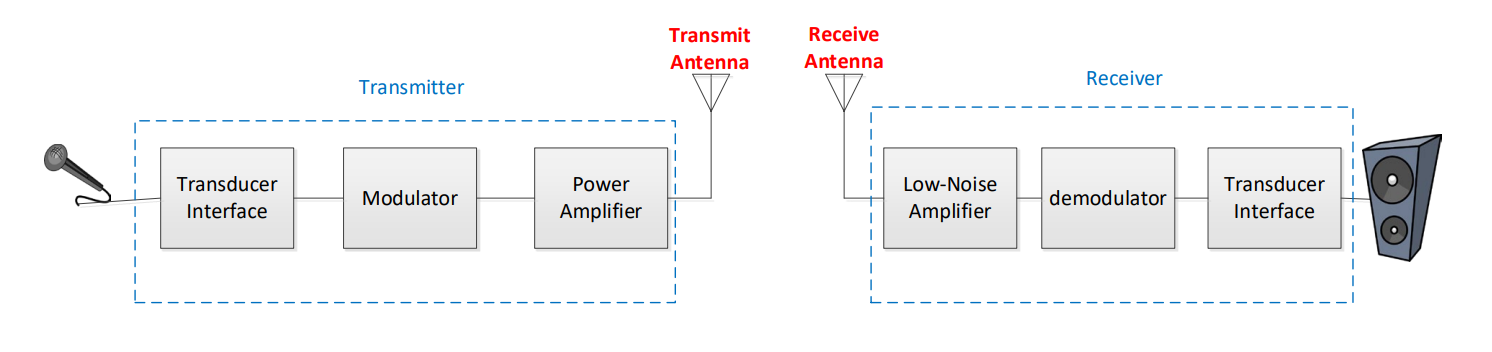
Fig. 1. Overview of a communications system showing where demodulation fits: the receiver recovers the original message from the modulated carrier.
Modulation Efficiency#
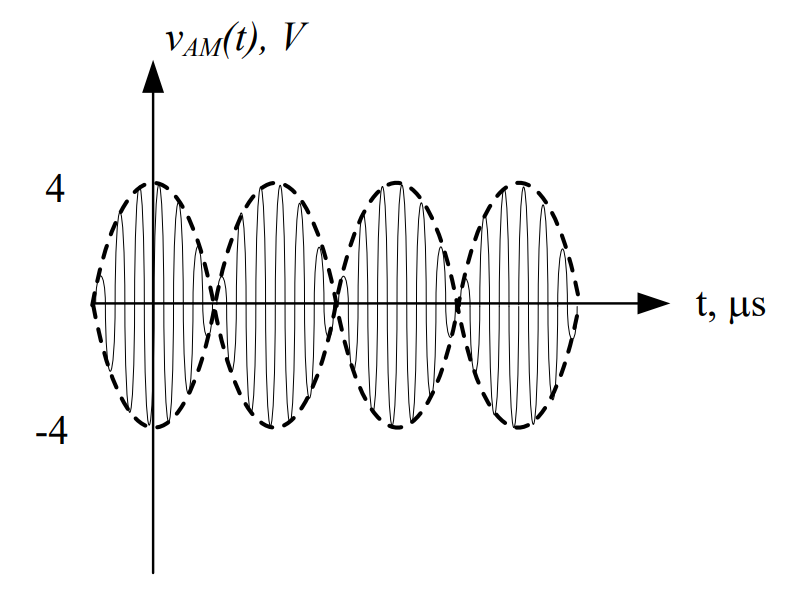
Previously, we introduced adding a bias signal before modulation. As bias increases, time-domain envelopes separate and a carrier spike appears in the frequency domain.
Two AM types:
DSB-SC: Information in sidebands only
DSB-LC: Information in sidebands; carrier transmitted alongside
Over-modulated |
100%-modulated |
Under-modulated |
|---|---|---|
\(\alpha \rightarrow \infty\) |
\(\alpha = 1\) |
\(\alpha = 0.667\) |
|
|
|
|
|
|
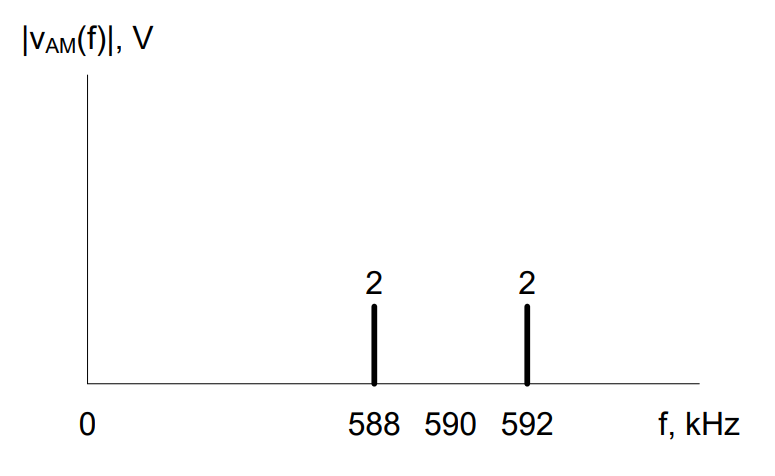
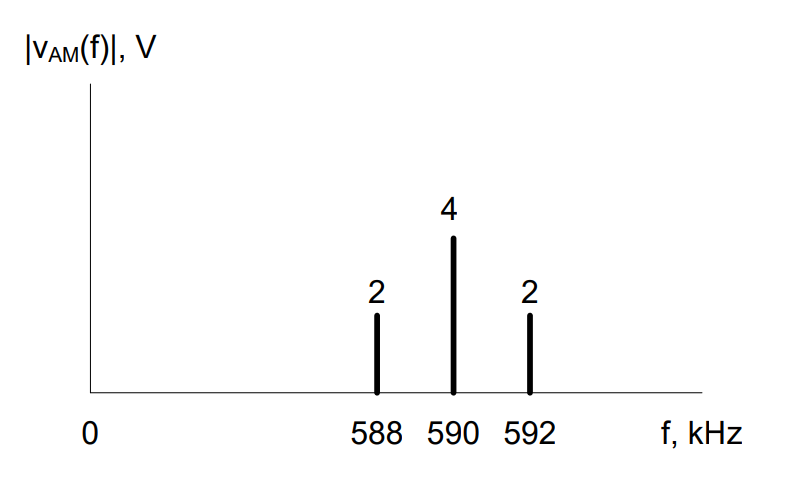
Efficiency is defined as:
Power:
With normalized resistance \(R = 1\ \Omega\):
AM Modulation Efficiency
DSB-SC: \(\eta = 100\%\)
\(\alpha = 1 \Rightarrow \eta = 0.33\)
Envelope Detector#
Under-modulated and 100%-modulated signals (\(\alpha \le 1\)) allow envelope detection.
Fig. 2. A demodulator recovers the message from the modulated signal. An envelope detector does this with a diode (rectification), an LPF (removes carrier), and an HPF (removes bias).
Steps:
Diode (rectification): Removes negative portion
LPF: Removes carrier
HPF: Removes bias
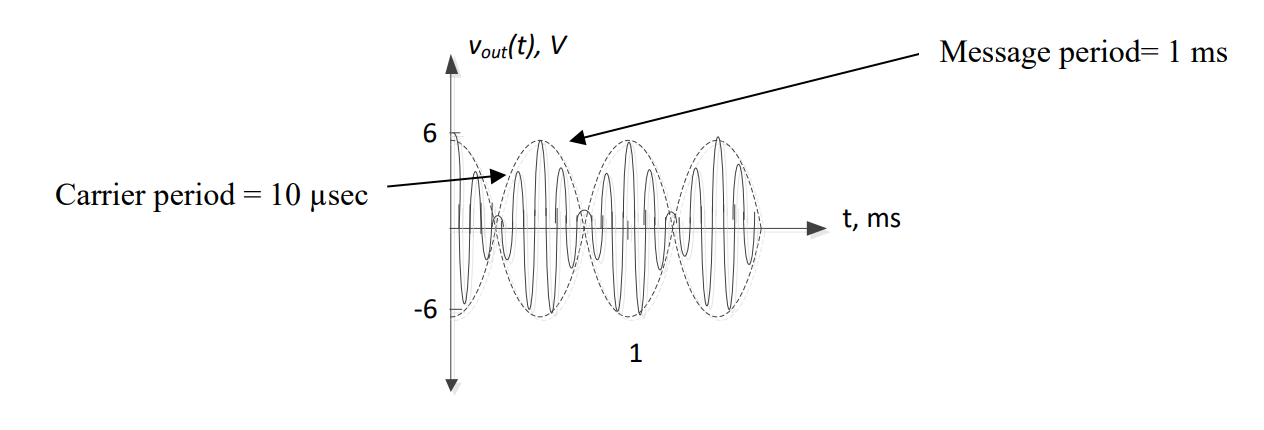
Fig. 3. Signal at each stage of the envelope detector: AM input → rectified (diode) → smoothed (LPF) → DC removed (HPF) → message output.
Example Problem 1
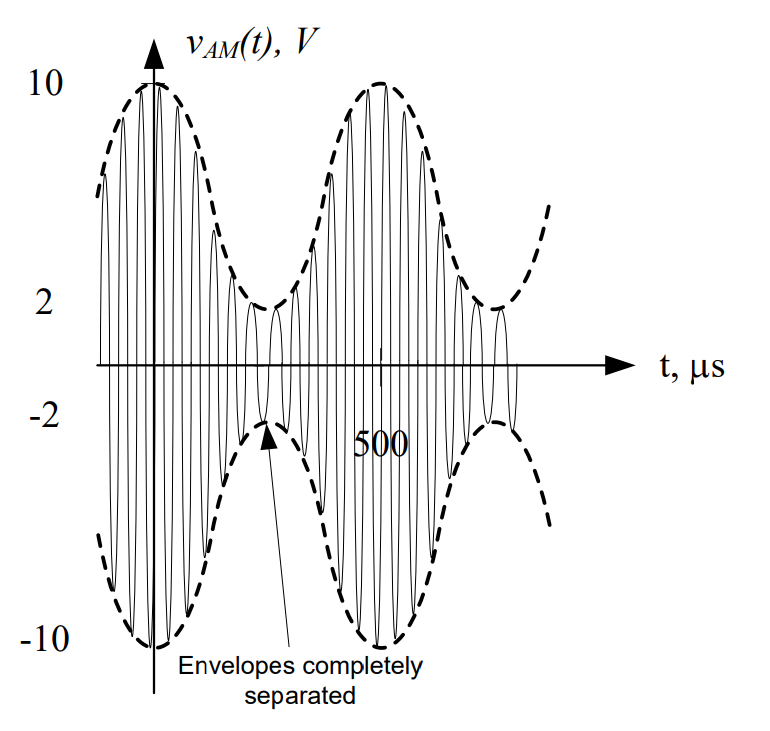
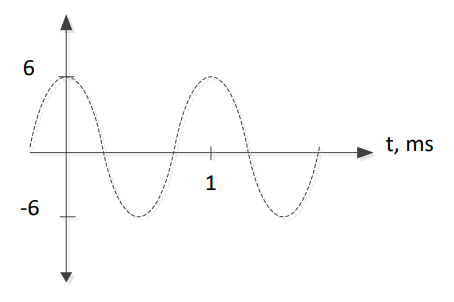
Design an envelope detector to recover the message from the AM signal shown below.
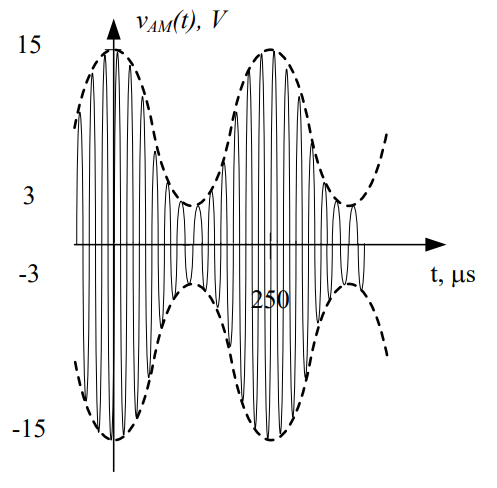
Understand: Under-modulated (\(\alpha \le 1\)) → envelope detector works.
Identify Key Information:
Known: \(T_M = 250\ \mu s\)
Unknown: carrier
Plan: Define LPF and HPF cutoff frequencies.
Solve:
LPF cutoff \(\ge 4\ kHz\)
HPF cutoff \(> 0\ Hz\) (use 10 Hz)
Envelope Detector Components and Rules#
Diode: removes negative voltages
LPF: removes carrier
HPF: removes bias
Rules:
\(f_{LPF} \ge f_{m,\ max}\)
\(f_{HPF} > 0\)
Envelope detectors do not work for:
Over-modulated signals
DSB-SC
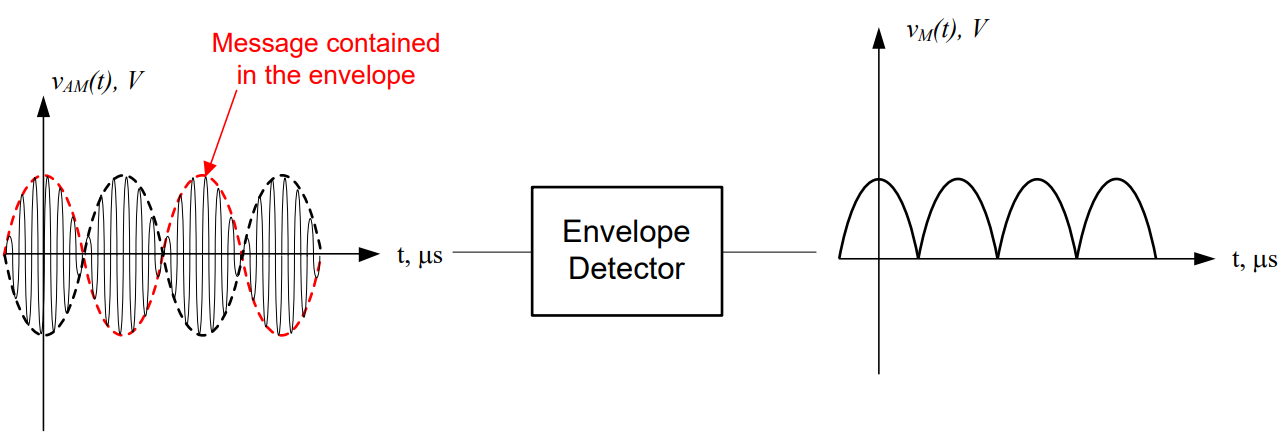
Fig. 4. Envelope detectors only work for under-modulated and 100%-modulated signals (\(\alpha \le 1\)) — over-modulated signals and DSB-SC cannot be recovered this way.
Synchronous Detector#
Used for all modulation types.
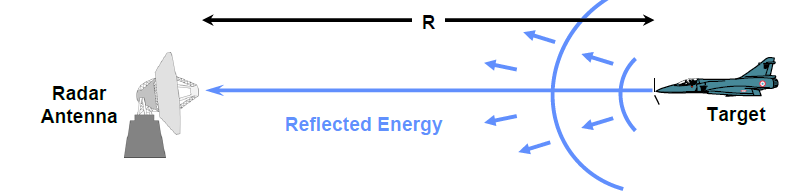
Fig. 5. Synchronous detector block diagram: modulated input is multiplied by the carrier frequency, then filtered to recover the message.
Multiply by carrier frequency:
Shift up: \(f + f_c\)
Shift down: \(f - f_c\)
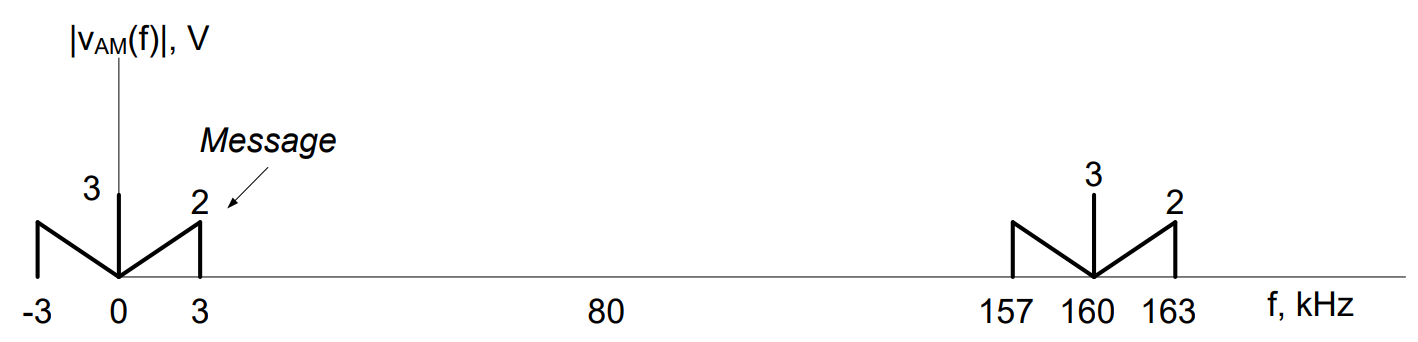
Fig. 6. Frequency shift after multiplying by carrier: sidebands shift up to \(f + f_c\) and down to \(f - f_c\), producing components at baseband and double-carrier frequencies.
Negative frequencies reflect and double amplitude.
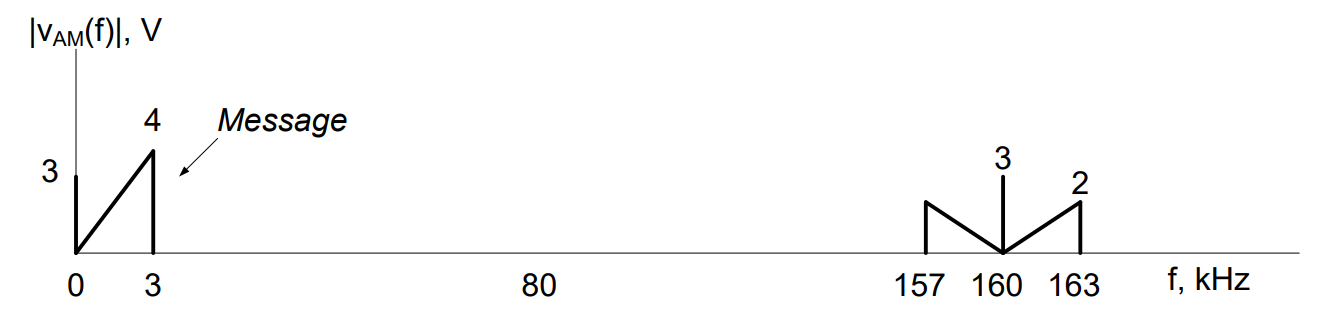
Fig. 7. Spectrum after reflecting negative frequencies: amplitudes at baseband double; the LPF then removes the high-frequency components.
Apply LPF:
Choose \(f_{LPF} \ge f_{m,\ max}\)
Then HPF:
Remove DC bias
Final Design#
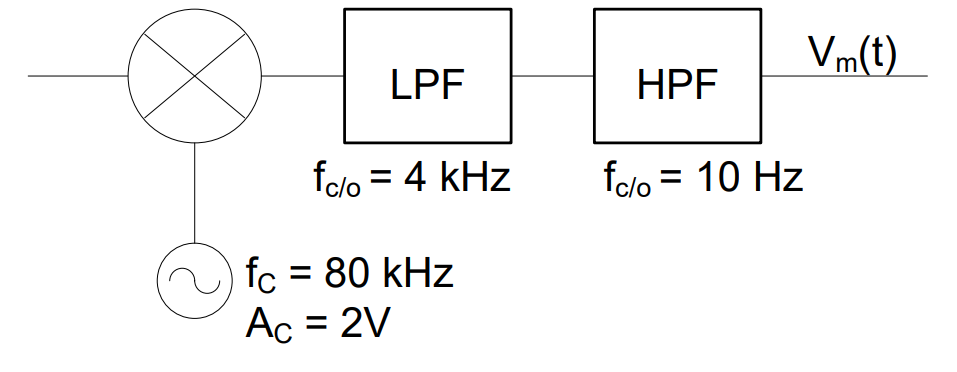
Fig. 8. Final synchronous demodulator design: multiplier (carrier frequency) → LPF (\(f_{LPF} \geq f_{m,\max}\)) → HPF (removes bias) → recovered message.
Components#
Multiplier: shifts to baseband
LPF: removes high-frequency content
HPF: removes bias
Design Rules#
Demodulating frequency = carrier frequency
\(f_{LPF} \ge f_{m,\ max}\)
\(f_{HPF} > 0\) (≈ 10 Hz)
Selecting a Station: HPF + LPF = BPF#
With Frequency-Division Multiplexing (FDM), many stations broadcast at the same time, each on its own carrier. Before demodulating, the receiver must keep ONE carrier and its sidebands (\(f_m\)) and reject all the other stations.
An HPF and an LPF connected in series do this job:
The HPF passes \(f > f_{HPF}\); the LPF passes \(f < f_{LPF}\).
In series, the responses multiply: \(|H_{BPF}| = |H_{HPF}| \times |H_{LPF}|\).
The order of the two filters does not matter.
The result is a band-pass filter (BPF) that passes frequencies from \(f_{HPF}\) to \(f_{LPF}\): the selected carrier gets in and the neighboring stations are kept out.
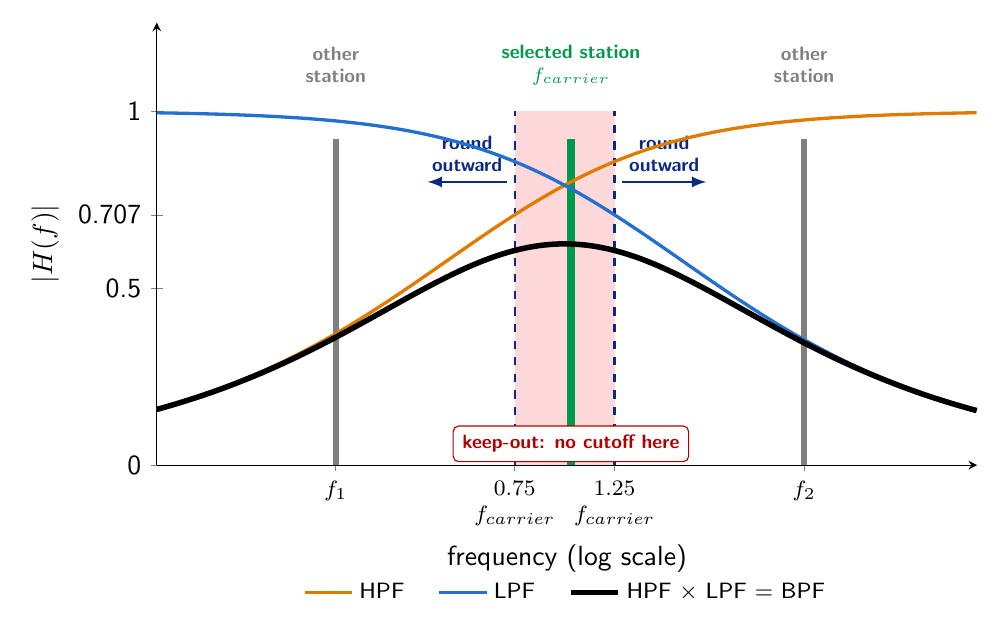
Fig. 9. An HPF and an LPF in series multiply to form a BPF. The selected station sits between the cutoff targets at \(0.75\,f_{carrier}\) and \(1.25\,f_{carrier}\); the other stations fall where the BPF response is low.
Band-Pass Design: Choosing the Cutoffs#
1. Set the targets with a 25% margin.
An analog filter is already down 3 dB (\(V_{out}/V_s = 0.707\)) at its cutoff frequency, so placing each cutoff 25% away from the carrier protects the carrier and its sidebands (\(f_m\)).
2. Choose the parts. Pick \(R\), then solve for \(C\):
The calculated \(C\) is rarely a value in the parts kit. Round to a kit value OUTWARD (away from the carrier), then recompute the cutoff with the kit value.
HPF: rounding outward means a lower cutoff, so round \(C\) up.
LPF: rounding outward means a higher cutoff, so round \(C\) down.
3. Check the keep-out zone. No cutoff may fall between \(0.75\,f_{carrier}\) and \(1.25\,f_{carrier}\).
The same idea applies to the LPF inside the envelope or synchronous detector. Its target is \(1.25\,f_m\) (which satisfies \(f_{LPF} \ge f_{m,\ max}\) with margin); round outward (up) from there, but keep the cutoff well below the carrier so the carrier is still removed.
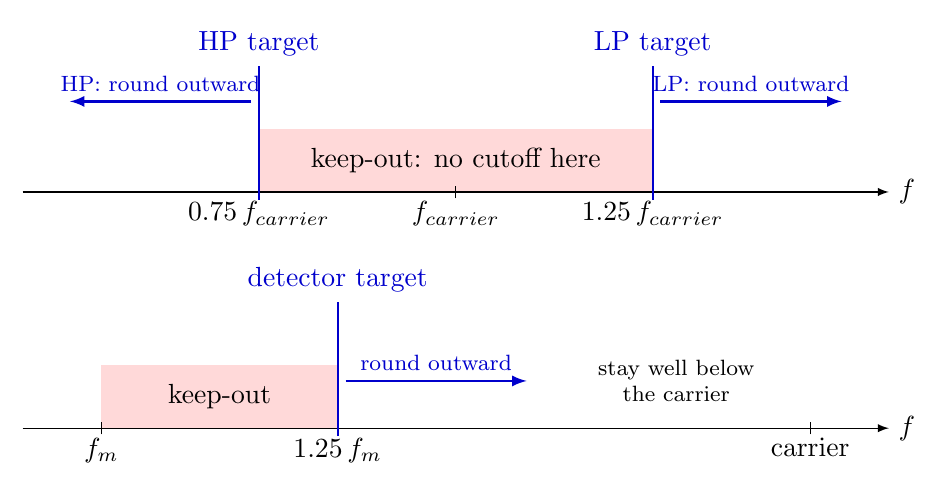
Fig. 10. Cutoff targets with a 25% margin. Top: the station-select BPF; kit values round outward, and no cutoff may fall in the keep-out zone. Bottom: the detector LPF targets \(1.25\,f_m\), rounds outward, and stays well below the carrier.
Demodulation Demo#
Each detector in this lesson is a chain of simple stages. The AM Demodulation Demo lets you switch those stages on one at a time and see the signal after each one. In the envelope detector, the diode rectifies the AM signal, the LPF traces the envelope, and the HPF removes the DC bias, leaving the original message. You can then over-modulate the input and compare what the envelope detector and the synchronous detector each recover.
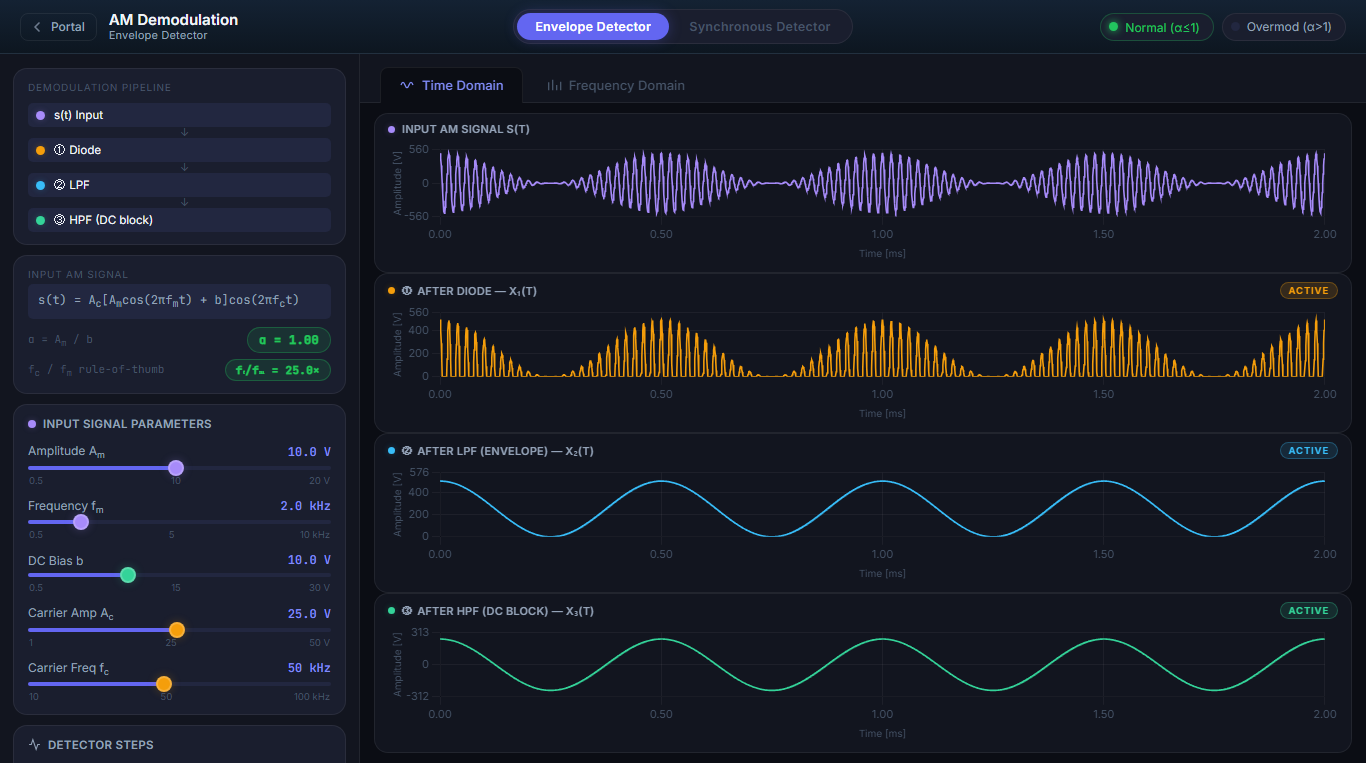
The AM Demodulation Demo with all three envelope detector stages switched on. Select the image to launch the demo.
Open the AM Demodulation Demo and try the experiments listed below it.
Key Takeaways#
Demodulation goal. Recover the original message signal from the received AM waveform by reversing the modulation process.
AM efficiency (\(\eta\)). The fraction of transmitted power that carries useful information; a lower modulation index wastes more power on the carrier and reduces efficiency.
Envelope detector. A simple circuit (diode → LPF → HPF) that recovers the message by following the amplitude envelope of the AM signal; only works when the modulation index \(\alpha \leq 1\).
Over-modulation failure. When \(\alpha > 1\) the carrier inverts during negative message peaks, causing the envelope detector to produce a distorted output — a synchronous detector must be used instead.
Synchronous (product) detector. Multiplies the received signal by a locally-generated carrier copy, shifting the sidebands back to baseband, then uses an LPF and HPF to extract the message; works for all modulation types and all modulation indices.
LPF cutoff rule. The low-pass filter must have \(f_{LPF} \geq f_{m,\max}\) to pass the full message bandwidth without cutting off high-frequency message components.
HPF role. The high-pass filter (with \(f_{HPF} \approx 10\ \text{Hz} > 0\)) removes the DC bias that was added during modulation, leaving only the recovered message signal.
Selecting a station. With FDM, an HPF and an LPF in series form a band-pass filter, \(|H_{BPF}| = |H_{HPF}| \times |H_{LPF}|\) (order does not matter), that keeps one carrier and its sidebands and rejects the neighboring stations.
25% margin. Set \(f_{HPF} = 0.75\,f_{carrier}\) and \(f_{LPF} = 1.25\,f_{carrier}\) because a filter is already down 3 dB (0.707) at its cutoff; no cutoff may fall in the keep-out zone between them. The detector LPF targets \(1.25\,f_m\) and stays well below the carrier.
Choosing parts. Pick \(R\), solve \(C = 1/(2\pi R f_{cutoff})\), round to a kit value OUTWARD (away from the carrier), then recompute the cutoff.