
Practice Problems (KEY)#
Answer the following questions about the two frequency domain graphs shown below.
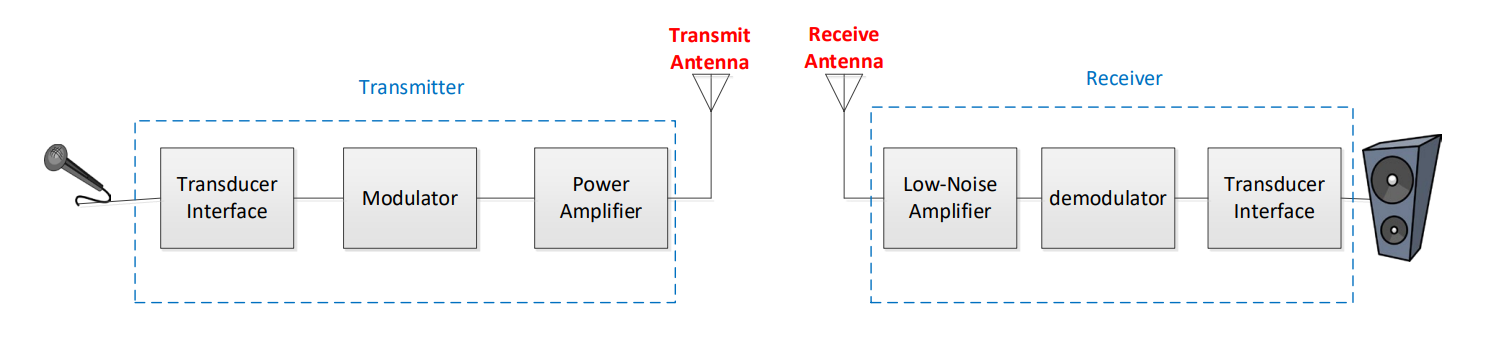
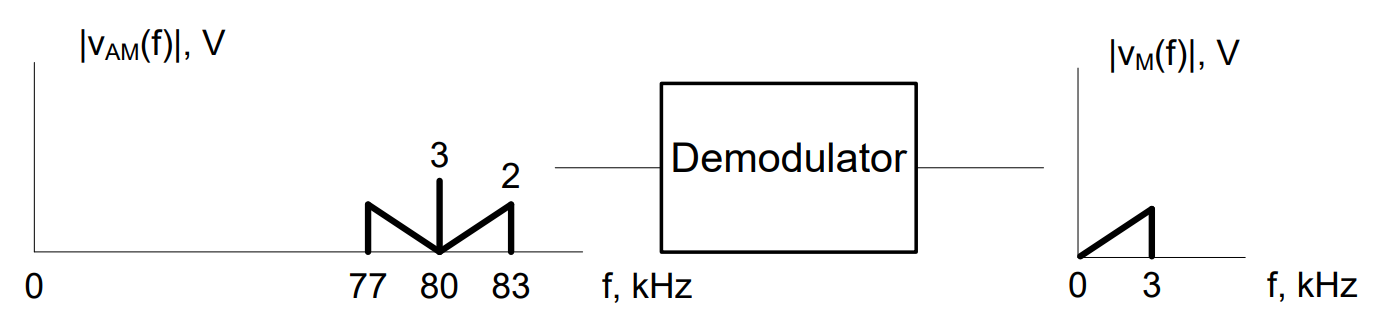
a. What is the modulation index for each system?
Left: $\( \frac{1}{2}A_m A_c = 4,\quad A_c B = 0 \)$
Right: $\( \frac{1}{2}A_m A_c = 4,\quad A_c B = 10 \)$
b. Will the output signal from each system be under-, over-, or 100% modulated?
Left: over-modulated
Right: under-modulated
c. What are the equations for the output signal, \(v_{AM}(t)\), of the system on the right?
In frequency modulation
a. The frequency of the carrier changes
b. The frequency of the message changes
c. The amplitude of the carrier changes
d. The amplitude of the message changes
In frequency modulation, the amplitude of the message signal causes changes in the frequency of the carrier.
T / F. The message is typically a higher frequency than the carrier.
Most messages have low frequency components. Voice and music are typically below 15 kHz. AM radio uses carrier frequencies from 540–1700 kHz, while FM radio uses carrier frequencies from 88–108 MHz.
T / F. In an AM signal, the message is contained in both the envelope and the frequency.
In an AM signal, the message is contained in the envelope alone.
T / F. FM signals are more susceptible to noise than AM signals.
FM signals have a constant envelope, so noise has less impact than in AM signals.
Given the following message and carrier signals:
Use identity:
Given:
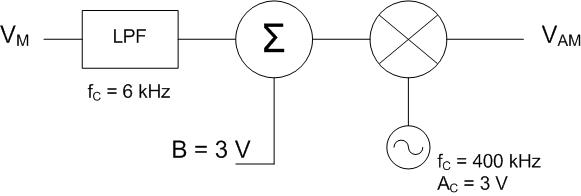
a. Modulation index:
b. Over-modulated
c. Output:
Bias = 8V
Under-modulated
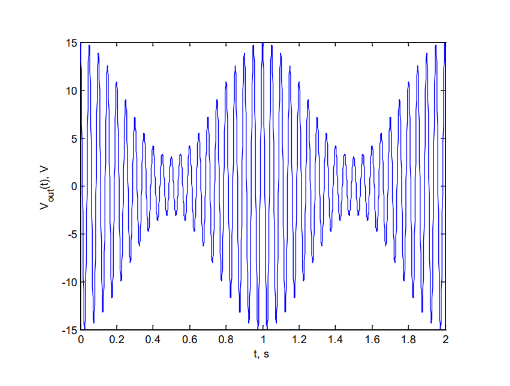
Amplitude modulation
Under-modulated