
Practice Problems (KEY)#
What is aliasing and how can it be prevented?
Aliasing is distortion caused by sampling a signal at a rate that is too low. It can be prevented by selecting a sampling frequency, \(f_s\), that is greater than or equal to the Nyquist rate:
Aliasing can also be prevented by pre-filtering the signal with a low-pass anti-aliasing filter before the ADC, with cutoff frequency \(f_c \le \frac{f_s}{2}\).
What are the three steps for converting an analog signal into digital?
Sampling — Taking discrete measurements of the signal in time at the sampling frequency, \(f_s\).
Quantizing — Assigning each sampled value to one of a finite number of discrete voltage levels.
Encoding — Converting the quantized level into a binary number for storage or transmission.
Given the following spectra, determine the minimum sampling frequency.
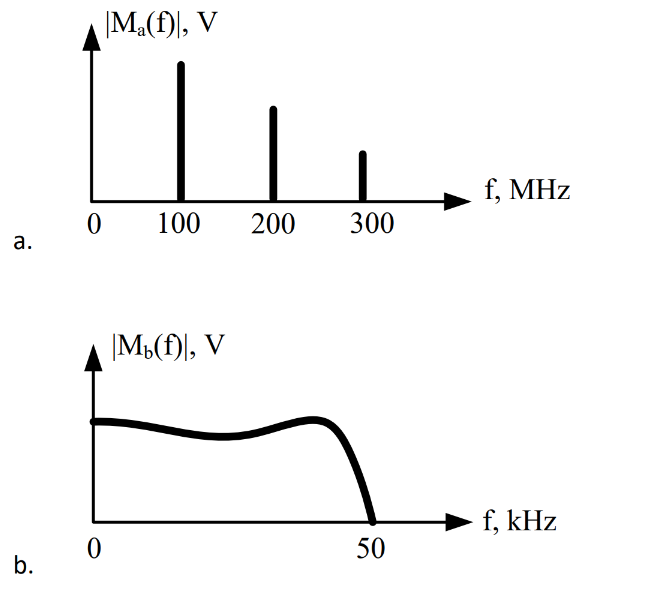
a.
b.
Find the number of levels and resolution for an 8-bit ADC with \(V_{\max} = 6\ \text{V}\) and \(V_{\min} = -4\ \text{V}\).
Given a cosine input \(v_{in}(t) = 1 + 3\cos\!\left(360^\circ (50\,\text{kHz})t\right)\ \text{V}\):
a. Nyquist rate (the sampling frequency must be at least this):
b. Use 120 kHz — the other options (75 kHz, 90 kHz) are below Nyquist and would cause aliasing.
c. Signal range: \(V_{\min} = 1 - 3 = -2\ \text{V}\), \(V_{\max} = 1 + 3 = 4\ \text{V}\)
d. \(V_{\max}=5\ \text{V}\), \(V_{\min}=-3\ \text{V}\) works (covers \(-2\) to \(4\ \text{V}\)). The other two clip the signal.
e. With \(V_{\max}=5\), \(V_{\min}=-3\), \(\Delta V \le 600\ \text{mV}\):
f. Actual resolution:
An input signal \(v_{in}(t) = 6 + 5\cos(360^\circ (6\,\text{kHz})t) + 3\cos(360^\circ (15\,\text{kHz})t)\ \text{V}\) is to be digitized using the ADC below.
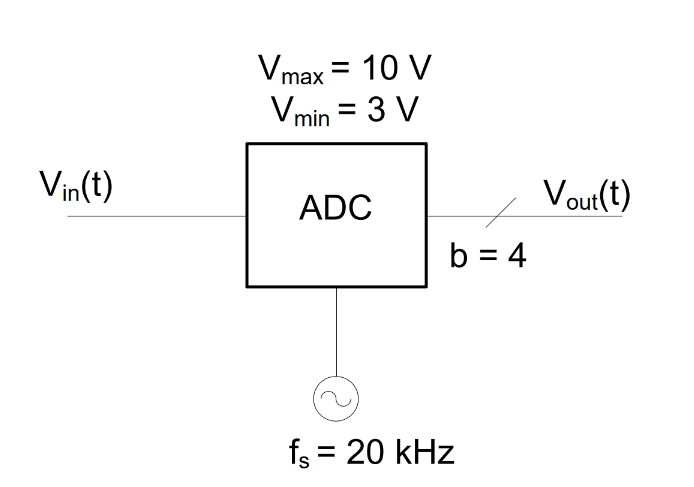
Aliasing check: Nyquist requires \(f_s \ge 2(15\ \text{kHz}) = 30\ \text{kHz}\), but \(f_{s,\text{ADC}} = 20\ \text{kHz}\) — aliasing will occur. Since the 15 kHz component is noise, apply a LPF (cutoff between 6 and 10 kHz) before the ADC to remove it.
Clipping check (after LPF): \(V_{\min} = 6 - 5 = 1\ \text{V}\), \(V_{\max} = 6 + 5 = 11\ \text{V}\) — clipping occurs. Apply a signal conditioning interface (\(K=0.7\), \(B=2.3\ \text{V}\)) to map into the ADC range.
What are the advantages of digital signals?
Less susceptible to noise
Easily stored and recovered
Easier encryption and signal processing
T / F. Improving the resolution is always better.
False. Increasing resolution (more bits) increases memory usage and required bandwidth — it’s an engineering tradeoff.
T / F. Increasing the sampling rate improves resolution.
False. Sampling rate and resolution are independent. \(f_s\) divides the signal along the time axis; resolution \(\Delta V\) divides the signal along the voltage axis.
T / F. A smaller resolution is a better resolution.
True (technically) — a smaller \(\Delta V\) means less quantization error. However, achieving it requires more bits, increasing memory and bandwidth requirements, so it involves an engineering tradeoff.
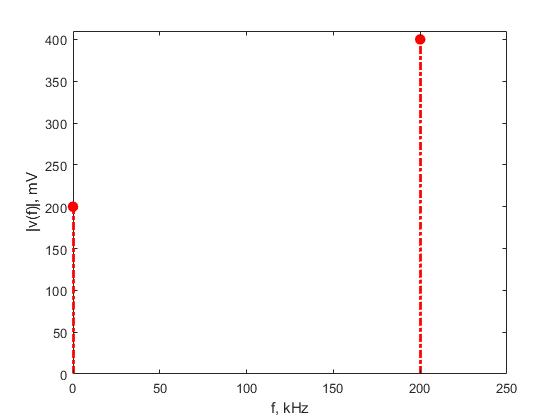
ADC: \(V_{\max} = 0.5\ \text{V}\), \(V_{\min} = -0.5\ \text{V}\), 3-bit. \(v(t) = 200 + 400\cos\!\left(360^\circ (200\,\text{kHz})t\right)\ \text{mV}\)
a. Amplitude spectrum:
b. Transducer interface: Signal range: \(v_{\min} = -200\ \text{mV}\), \(v_{\max} = 600\ \text{mV}\). Solve for \(K\) and \(B\):
c. Sampling rate: \(f_s \ge 2(200\ \text{kHz}) = 400\ \text{kHz}\), so choose any rate at or above \(400\ \text{kHz}\) (for example, \(500\ \text{kHz}\)).
d. Resolution:
e. Encoded output for 315 mV input:
What is the resolution of a 10-bit ADC with \(V_{\max} = 5\ \text{V}\) and \(V_{\min} = -3\ \text{V}\)?
Given \(V(t) = \cos\!\left(360^\circ (8\,\text{kHz})t\right) + 2\cos\!\left(360^\circ (15\,\text{kHz})t\right)\ \text{V}\), create an ADC with 5 bits and determine resolution.

Signal limits: \(V_{\min} = -3\ \text{V}\), \(V_{\max} = 3\ \text{V}\)
Sampling rate: \(f_s \ge 2(15\ \text{kHz}) = 30\ \text{kHz}\)
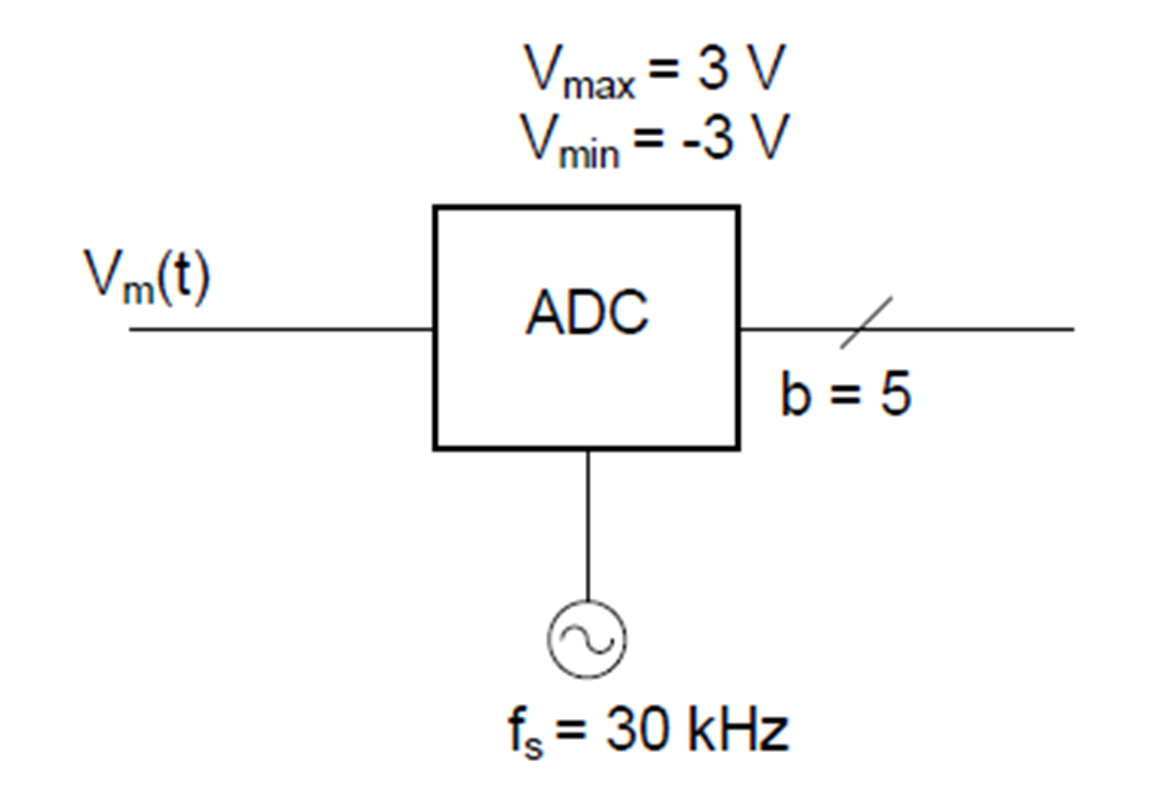
b. Encode \(1.62\ \text{V}\):

Given \(v_{in}(t) = 4 + 4\cos\!\left(360^\circ (2\,\text{kHz})t\right)\ \text{V}\), \(\text{max } QE = 200\ \text{mV}\):
Signal limits: \(V_{\min} = 0\ \text{V}\), \(V_{\max} = 8\ \text{V}\)
Sampling rate: \(f_s \ge 2(2\ \text{kHz}) = 4\ \text{kHz}\)
Bits required. Since \(|QE|_{\max} = \frac{\Delta V}{2}\), the resolution must satisfy \(\Delta V \le 2(200\ \text{mV}) = 400\ \text{mV/level}\):
Actual resolution:
For \(V_{in} = 1.6\ \text{V}\):