Practice Problems (KEY)
Problem 1
Convert the following values into impedances:
a. \(C = 10\ \mu\text{F}\), \(f = 200\ \text{Hz}\)
\[
Z_{C} = \frac{-j}{2\pi(200\ \text{Hz})(10\times10^{-6}\ \text{F})}
= -j79.6\ \Omega
\]
b. \(L = 20\ \text{mH}\), \(f = 20\ \text{Hz}\)
\[
Z_{L} = j\omega L = j(2\pi)(20\ \text{Hz})(0.020\ \text{H})
= j2.51\ \Omega
\]
c. \(R = 15\ \Omega\), \(f = 100\ \text{Hz}\)
\[
Z_{R} = R = 15\ \Omega
\]
Problem 2
In a given circuit, if \(v_{s}(t) = 100\cos(360^\circ \cdot 1k\,t)\ \text{V}\), determine the impedances of the following components:
a. \(R = 100\ \Omega\)
\[
Z_{R} = R = 100\ \Omega
\]
b. \(C = 66\ \mu\text{F}\)
\[
Z_{C} = \frac{-j}{2\pi(1000\ \text{Hz})(66\times10^{-6}\ \text{F})}
= -j2.41\ \Omega
\]
c. \(L = 10\ \text{mH}\)
\[
Z_{L} = j\omega L = j(2\pi)(1000\ \text{Hz})(0.010\ \text{H})
= j62.8\ \Omega
\]
Problem 3
In a given circuit, if \(v_{s}(t) = 100\cos(360^\circ \cdot 500t)\ \text{V}\), determine the impedances of the following components:
a. \(R = 150\ \Omega\)
\[
Z_{R} = R = 150\ \Omega
\]
b. \(C = 270\ \mu\text{F}\)
\[
Z_{C} = \frac{-j}{2\pi(500\ \text{Hz})(270\times10^{-6}\ \text{F})}
= -j1.18\ \Omega
\]
c. \(L = 144\ \text{mH}\)
\[
Z_{L} = j\omega L = j(2\pi)(500\ \text{Hz})(0.144\ \text{H})
= j452\ \Omega
\]
Problem 4
Convert the voltage source values to phasor RMS values
a. \(v_{s}(t) = 5\cos(360^\circ \cdot 100t)\ \text{V}\)
\[
\widetilde{V}_{s} = \frac{5}{\sqrt{2}}\angle 0^\circ
= 3.54V_{\text{RMS}}\angle 0^\circ
\]
b. \(v_{s}(t) = 377\cos(360^\circ \cdot 60k\,t + 30^\circ)\ \text{V}\)
\[
\widetilde{V}_{s} = \frac{377}{\sqrt{2}}\angle 30^\circ
= 266.58V_{\text{RMS}}\angle 30^\circ
\]
c. \(v_{s}(t) = 169.73\cos(360^\circ \cdot 400t - 45^\circ)\ \text{V}\)
\[
\widetilde{V}_{s} = \frac{169.73}{\sqrt{2}}\angle (-45^\circ)
= 120V_{\text{RMS}}\angle (-45^\circ)
\]
Problem 5
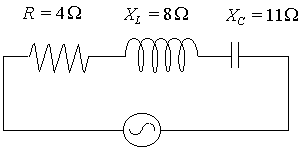
For the circuit below, determine the equivalent impedance. Then write a voltage divider equation to determine the voltage drop over the inductor. The source is \(V_{in} = 10\angle 0^\circ\ \text{V}_{\text{RMS}}\).
\[
Z_{eq} = Z_{R} + Z_{L} + Z_{C}
= 4 + j8 - j11
= (4 - j3)\ \Omega
= 5\angle -36.9^\circ\ \Omega
\]
\[
V_{L} = \frac{Z_{L}}{Z_{eq}}V_{in}
= \frac{j8}{4 - j3}\left(10\angle 0^\circ\right)
= 16\angle 126.9^\circ\ \text{V}_{\text{RMS}}
\]
Problem 6
The circuit below is operating at \(400\ \text{Hz}\). Determine the equivalent impedance. What is the voltage and current drop over each component when \(V_{S} = 150\ \text{V}\angle 0^\circ\), \(R = 1k\Omega\), \(L = 30\ \text{mH}\), and \(C = 20\ \mu\text{F}\)? Also, find \(I_{S}\) without using \(Z_{eq}\).

\[
Z_{R} = 1k\Omega
\]
\[
Z_{L} = j\omega L = j(2\pi)(400\ \text{Hz})(0.03\ \text{H})
= j75.4\ \Omega
\]
\[
Z_{C} = \frac{-j}{2\pi(400\ \text{Hz})(20\times10^{-6}\ \text{F})}
= -j19.9\ \Omega
\]
\[
Z_{eq}
= \left(
\frac{1}{1000}
+ \frac{1}{j75.4}
+ \frac{1}{-j19.9}
\right)^{-1}
= 0.7298 - j27\ \Omega
= 27\angle -88^\circ\ \Omega
\]
\[
V_{s} = V_{R} = V_{L} = V_{C}
= 150\angle 0^\circ\ \text{V}
\]
\[
I_{R}
= \frac{V_{R}}{Z_{R}}
= \frac{150\angle 0^\circ}{1000\ \Omega}
= 150\ \text{mA}\angle 0^\circ
\]
\[
I_{L}
= \frac{V_{L}}{Z_{L}}
= \frac{150\angle 0^\circ}{j75.4\ \Omega}
= 1.99\ \text{A}\angle -90^\circ
\]
\[
I_{C}
= \frac{V_{C}}{Z_{C}}
= \frac{150\angle 0^\circ}{-j19.9\ \Omega}
= 7.54\ \text{A}\angle 90^\circ
\]
By KCL,
\[
I_{S}
= I_{R} + I_{L} + I_{C}
= 150\ \text{mA}\angle 0^\circ
+ 1.99\ \text{A}\angle -90^\circ
+ 7.54\ \text{A}\angle 90^\circ
= 5.55\ \text{A}\angle 88.5^\circ
\]
Problem 7
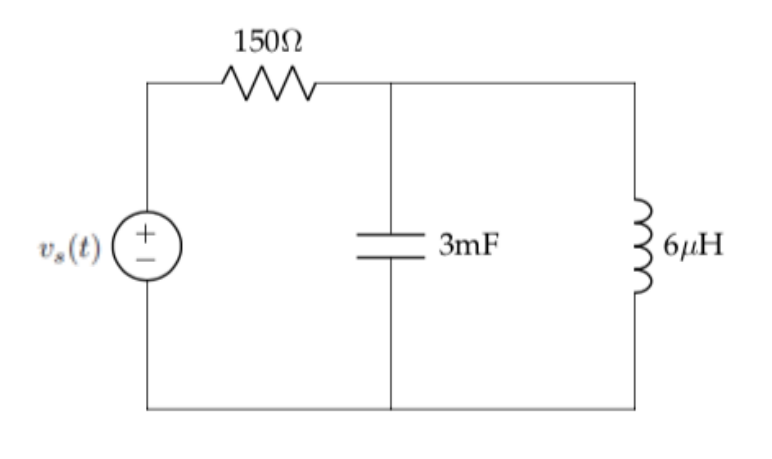
For the circuit below, determine the equivalent impedance, given the input frequency is \(2\ \text{kHz}\), \(L = 27\ \text{mH}\), \(C = 150\ \text{nF}\), and \(R = 5k\Omega\).
\[
Z_{R} = R = 5k\Omega
\]
\[
Z_{L} = j\omega L = j(2\pi)(2000\ \text{Hz})(0.027\ \text{H})
= j339.3\ \Omega
\]
\[
Z_{C} = \frac{-j}{2\pi(2000\ \text{Hz})(150\times10^{-9}\ \text{F})}
= -j530.5\ \Omega
\]
\[
Z_{eq}
= -j530.5\ \Omega
+ \left(
\frac{1}{5000\ \Omega}
+ \frac{1}{j339.3\ \Omega}
\right)^{-1}
= 22.9 - j193\ \Omega
= 194\angle -83.2^\circ\ \Omega
\]
Problem 8
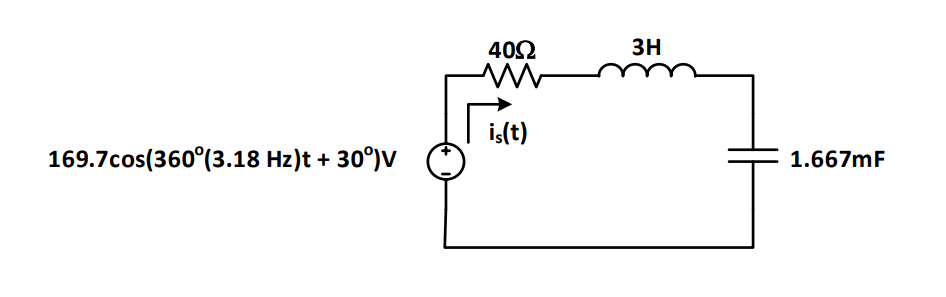
For the circuit below, determine the equivalent impedance, given the input frequency is \(60\ \text{Hz}\), \(R = 20\ \Omega\), \(C = 15\ \text{nF}\), and \(L = 2\ \text{mH}\).
\[
Z_{R} = 20\ \Omega
\]
\[
Z_{L} = j\omega L = j(2\pi)(60\ \text{Hz})(0.002\ \text{H})
= j0.754\ \Omega
\]
\[
Z_{C} = \frac{-j}{2\pi(60\ \text{Hz})(15\times10^{-9}\ \text{F})}
= -j176.8k\ \Omega
\]
\[
Z_{eq}
= 20
+ \left(
\frac{1}{-j176800}
+ \frac{1}{j0.754}
\right)^{-1}
= 20 + j0.754\ \Omega
= 20.0\ \Omega\angle 2.16^\circ
\]
Problem 9
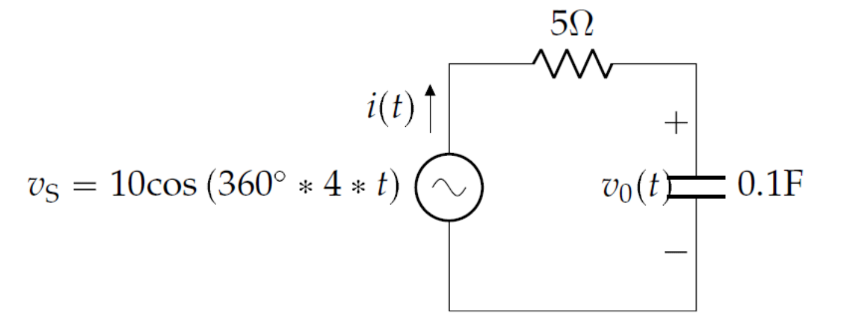
For the circuit below, find \(v_{0}(t)\) and \(i(t)\).
\[
Z_{R} = 5\ \Omega
\]
\[
Z_{C} = \frac{-j}{2\pi(4\ \text{Hz})(0.1\ \text{F})}
= -j0.398\ \Omega
\]
\[
Z_{eq} = 5 - j0.398\ \Omega
\]
\[
\widetilde{V}_{s}
= \frac{10}{\sqrt{2}}V_{\text{RMS}}\angle 0^\circ
= 7.07V_{\text{RMS}}\angle 0^\circ
\]
\[
\widetilde{V}_{o}
= \frac{Z_{C}}{Z_{eq}}\widetilde{V}_{s}
= \frac{-j0.398}{5 - j0.398}
\left( 7.07V_{\text{RMS}}\angle 0^\circ \right)
= 561\ \text{mV}\angle (-85.4^\circ)
\]
\[
v_{o}(t)
= (561\sqrt{2})\cos(360^\circ \cdot 4t - 85.4^\circ)\ \text{mV}
= 793\cos(360^\circ \cdot 4t - 85.4^\circ)\ \text{mV}
\]
\[
I_{S}
= \frac{\widetilde{V}_{s}}{Z_{eq}}
= \frac{7.07V_{\text{RMS}}\angle 0^\circ}{5.016\ \Omega\angle -4.55^\circ}
= 1.41A_{\text{RMS}}\angle 4.55^\circ
\]
\[
i_{s}(t)
= (1.41\sqrt{2})\cos(360^\circ \cdot 4t + 4.55^\circ)\ \text{A}
= 1.99\cos(360^\circ \cdot 4t + 4.55^\circ)\ \text{A}
\]
Problem 10
For the circuit below, find \(\widetilde{V_{o}}\) and the current flowing through the capacitor.
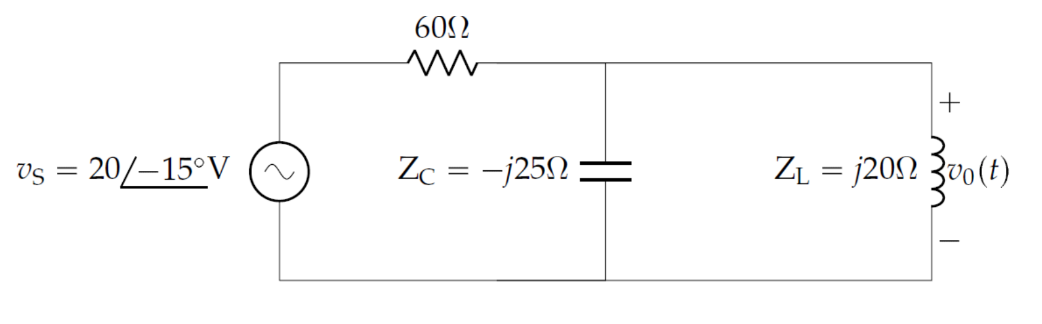
\[
Z_{R} = 60\ \Omega
\qquad
Z_{C} = -j25\ \Omega
\qquad
Z_{L} = j20\ \Omega
\]
\[
Z_{eq} = Z_{R} + Z_{CL}
= 60 + \left(\frac{1}{-j25} + \frac{1}{j20}\right)^{-1}
= 60 + j100\ \Omega
= 116.6\ \Omega\angle 59.04^\circ
\]
\[
\widetilde{V}_{o}
= \frac{Z_{CL}}{Z_{eq}}\widetilde{V}_{in}
= \frac{j100}{60 + j100}\left(20V_{\text{RMS}}\angle -15^\circ\right)
= 17.1V_{\text{RMS}}\angle 16^\circ
\]
\[
I_{C}
= \frac{\widetilde{V}_{o}}{Z_{C}}
= \frac{17.1V_{\text{RMS}}\angle 16^\circ}{25\ \Omega\angle -90^\circ}
= 684\ \text{mA}_{\text{RMS}}\angle 106^\circ
\]