
Practice Problems#
Answer the following questions about the two modulated signals shown below.
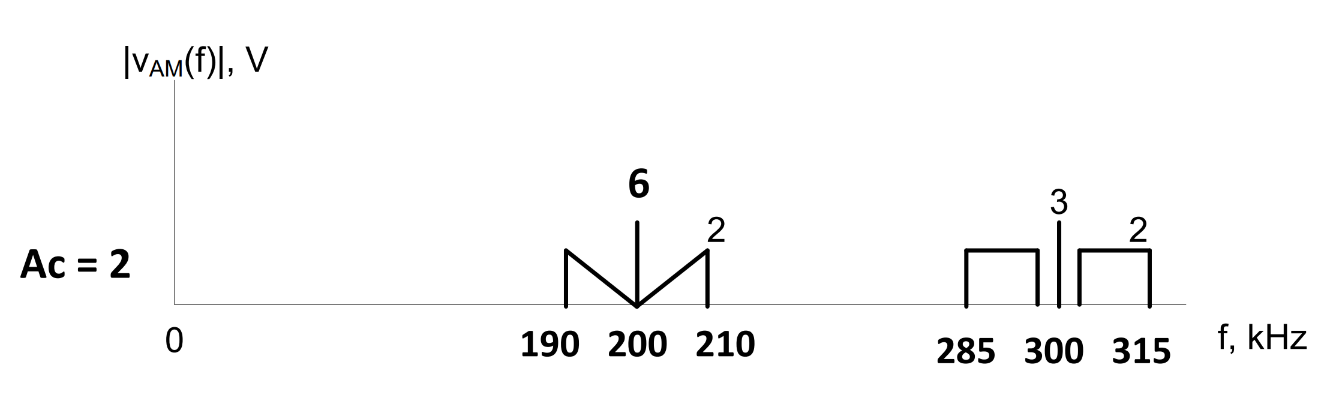
a. Find \(\alpha\).
b. Is this over-, under-, or 100%-modulated?
c. What kind of detectors can you use?
d. Design a demodulator for each signal and explain why you chose that demodulator.
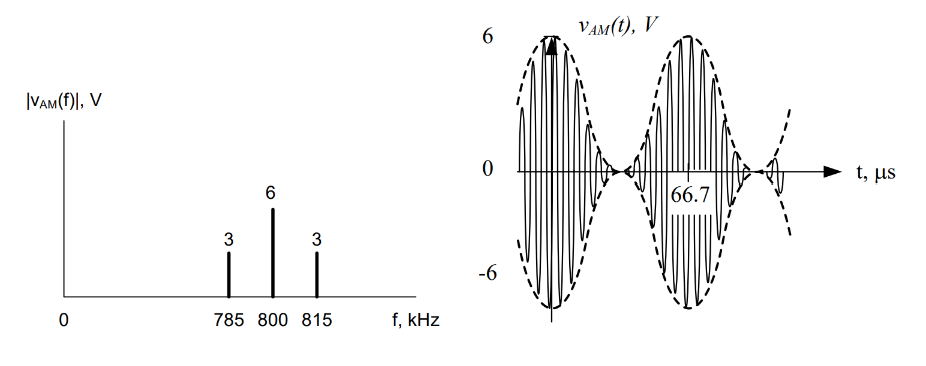
The output signal of an AM modulator is shown below in both the time and frequency domains. Since the signal is 100%-modulated, design an envelope detector to demodulate the signal.
Given the following AM signals on the frequency spectrum:
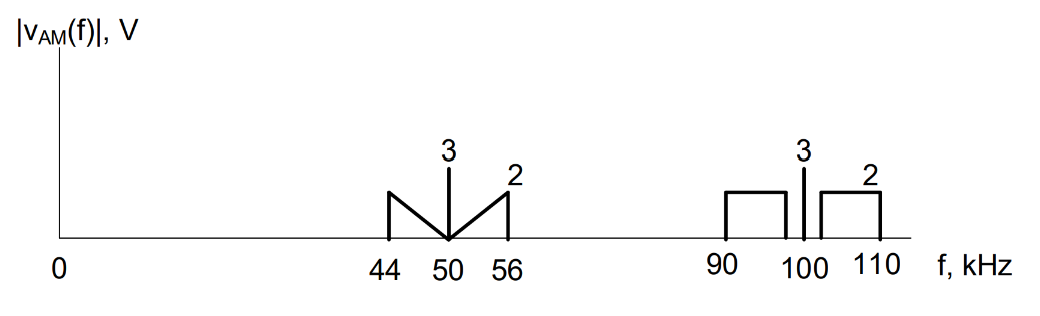
Design a synchronous detector to recover the message signal centered at 100 kHz.
Given the following AM signal, answer the questions below. Assume \(A_c = 1\ \text{V}\).
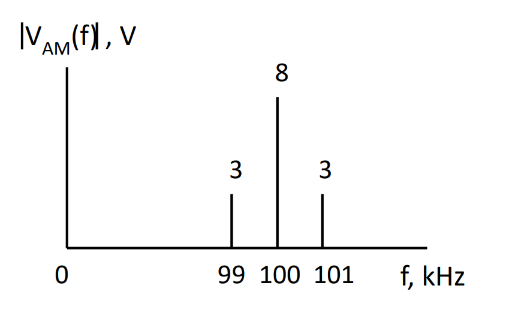
a. What is the modulation index, \(\alpha\), of this signal?
b. What is the power efficiency, \(\eta\), of this signal?
c. Identify one pro and one con of increasing the modulation index to \(\alpha = 3\).
What is the purpose of the diode in an envelope detector?
a. Kill the bias
b. Kill the negative voltages
c. Kill the carrier
What is the purpose of the high-pass filter in a synchronous detector?
a. Kill the bias
b. Kill the negative voltages
c. Kill the carrier