
Practice Problems#
Plot the following equations:
a) \(v(t) = -2 + 2\cos(360°\cdot 100\ \text{Hz}\cdot t)\ \text{mV}\)
b) \(v(t) = 2\cos(360°\cdot 10\ \text{Hz}\cdot t)\ \text{V}\)
c) \(v(t) = 4\cos(360°\cdot 1\ \text{kHz}\cdot t)\ \text{mV}\)
d) What equation is associated with the graph?
e) What equation is associated with the graph?
f) What equation is associated with the graph?
If \(v_S(t) = 4 + 8\cos(360°\cdot 10\ \text{kHz}\cdot t)\ \text{V}\), graph \(i_X(t)\) for the signal below.
Find the power consumed by the circuit below given \(V_S = 1.5\ \text{V}\).
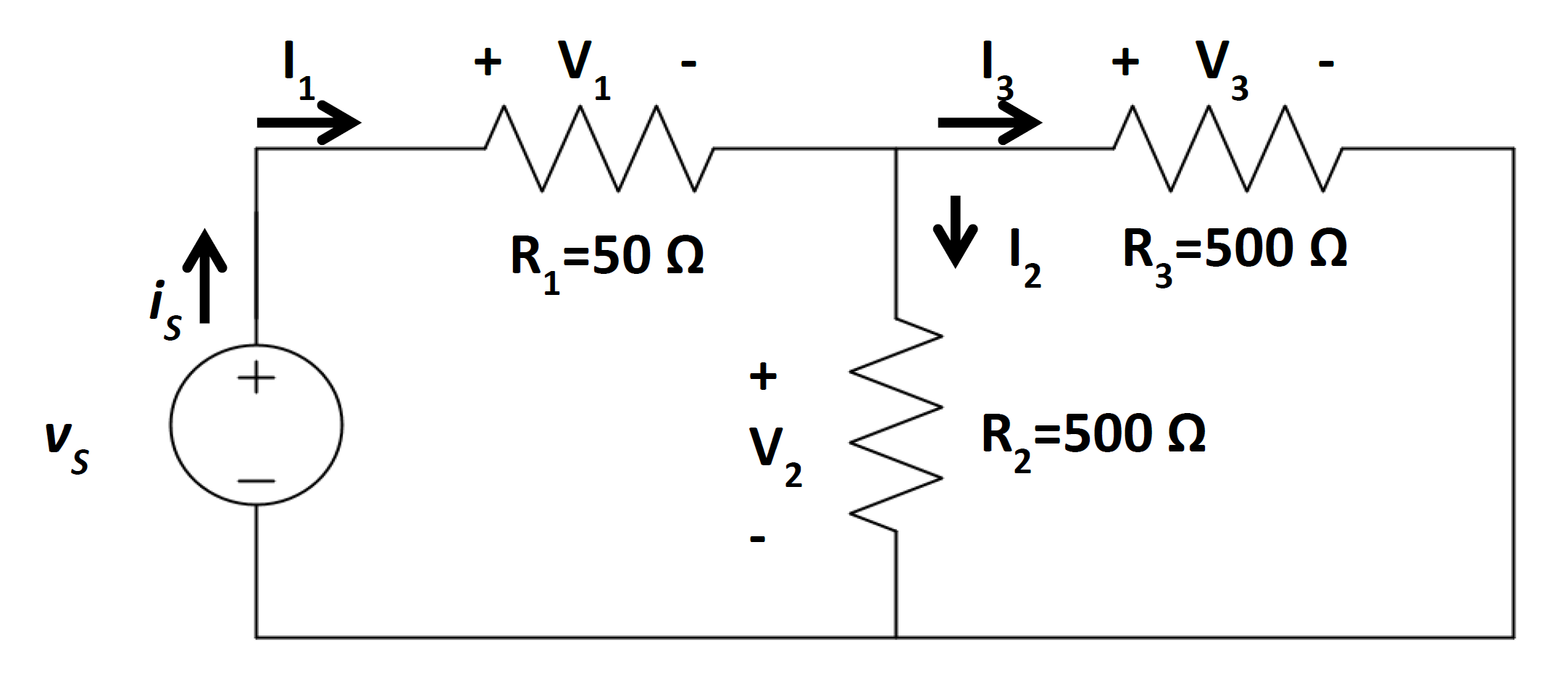
Find the average power consumed by the circuit below given:
\(v_S(t) = 2.12\cos(360°\cdot 100\ \text{kHz}\cdot t)\ \text{V}\)
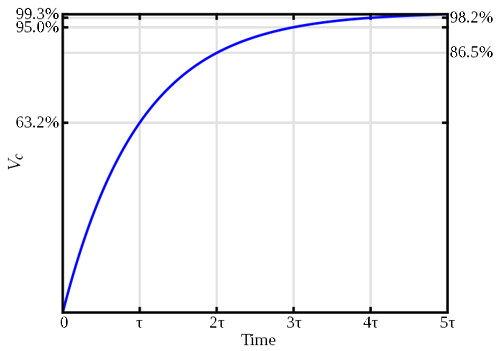
Compare the power consumed by the two circuits (Problems 3 and 4). What can you say about the power consumed?
What is \(\frac{1}{\text{Hz}}\) equivalent to?
a. s b. 1/s c. f d. None of the above
A 9 V battery is connected to a resistor that consumes 7.22 mW of power. Which of the following AC sources would cause the same resistor to consume 7.22 mW of average power?
a. \(7.22\cos(360°\cdot 2\ \text{kHz}\cdot t)\ \text{mV}\)
b. \(9\cos(360°\cdot 2\ \text{kHz}\cdot t)\ \text{V}\)
c. \(7.22\ \text{mV}_{RMS}\)
d. \(9\ \text{V}_{RMS}\)
A B-52 generator produces the signal \(v(t) = 290\cos(360°\cdot 400\ \text{Hz}\cdot t)\ \text{V}\).
a. Graph this signal as a function of time.
b. What is the RMS voltage for the generator above?
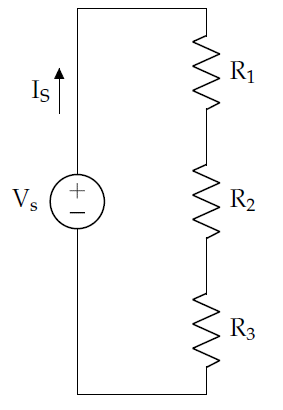
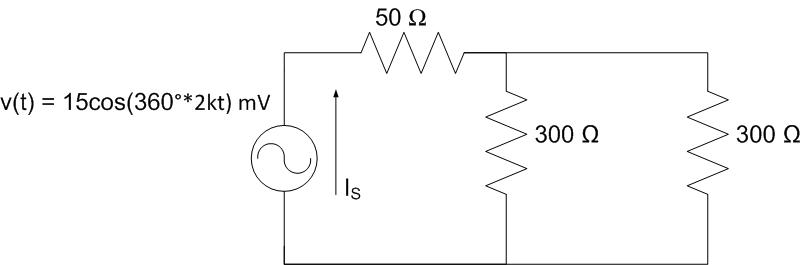
The fuse for a 2000-lb general-purpose bomb includes a spinner producing \(v(t) = 15\cos(360°\cdot 2\ \text{kHz}\cdot t)\ \text{mV}\). The arming circuit is modeled as three resistors, as shown below. Graph the current signal coming out of the spinner, \(I_S(t)\).
Which of the two sources below produces more average power?
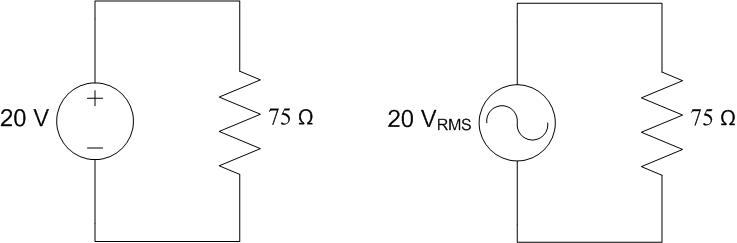
The circuit below has a current source providing \(i(t) = 11.75\cos(360°\cdot 50\ \text{Hz}\cdot t)\ \text{A}\).
Find \(v_1(t)\).

An AC-powered electric fan, modeled as a 150 Ω resistor, is plugged into a standard 120 VRMS wall outlet. Since the fan requires 90 VRMS to operate, a resistor is added to form a voltage divider.
Given:
\(V_S = 120\ \text{V}_{RMS}\)
\(R_{fan} = 150\ \Omega\)
Find the resistor value \(R_{\text{adapter}}\) required to provide the fan with 90 VRMS.