Practice Problems#
Convert the following values into impedances:
a. \(C = 10\ \mu\text{F}\), \(f = 200\ \text{Hz}\)
b. \(L = 20\ \text{mH}\), \(f = 20\ \text{Hz}\)
c. \(R = 15\ \Omega\), \(f = 100\ \text{Hz}\)
In a given circuit, if \(v_{s}(t) = 100\cos(360^\circ \cdot 1k\,t)\ \text{V}\), determine the impedances of the following components:
a. \(R = 100\ \Omega\)
b. \(C = 66\ \mu\text{F}\)
c. \(L = 10\ \text{mH}\)
In a given circuit, if \(v_{s}(t) = 100\cos(360^\circ \cdot 500t)\ \text{V}\), determine the impedances of the following components:
a. \(R = 150\ \Omega\)
b. \(C = 270\ \mu\text{F}\)
c. \(L = 144\ \text{mH}\)
Convert the voltage source values to phasor RMS values
a. \(v_{s}(t) = 5\cos(360^\circ \cdot 100t)\ \text{V}\)
b. \(v_{s}(t) = 377\cos(360^\circ \cdot 60k\,t + 30^\circ)\ \text{V}\)
c. \(v_{s}(t) = 169.73\cos(360^\circ \cdot 400t - 45^\circ)\ \text{V}\)
For the circuit below, determine the equivalent impedance. Then write a voltage divider equation to determine the voltage drop over the inductor. The source is \(V_{in} = 10\angle 0^\circ\ \text{V}_{\text{RMS}}\).
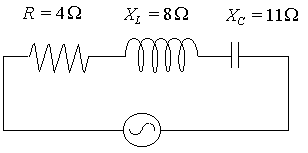
The circuit below is operating at \(400\ \text{Hz}\). Determine the equivalent impedance. What is the voltage and current drop over each component when \(V_{S} = 150\ \text{V}\angle 0^\circ\), \(R = 1k\Omega\), \(L = 30\ \text{mH}\), and \(C = 20\ \mu\text{F}\)? Also, find \(I_{S}\) without using \(Z_{eq}\).

For the circuit below, determine the equivalent impedance, given the input frequency is \(2\ \text{kHz}\), \(L = 27\ \text{mH}\), \(C = 150\ \text{nF}\), and \(R = 5k\Omega\).
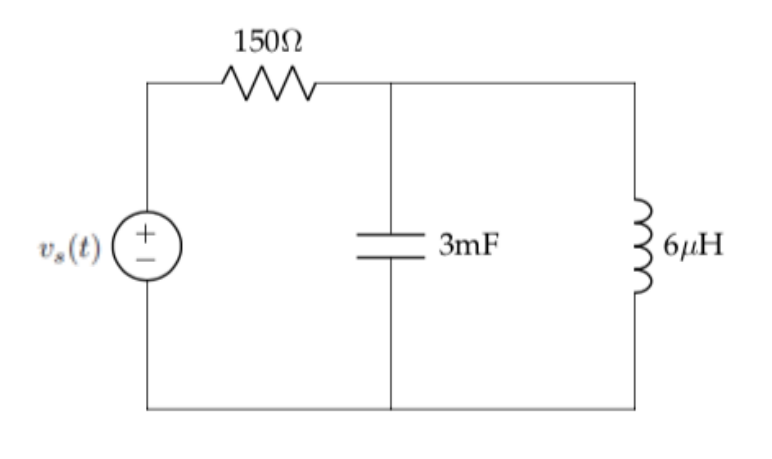
For the circuit below, determine the equivalent impedance, given the input frequency is \(60\ \text{Hz}\), \(R = 20\ \Omega\), \(C = 15\ \text{nF}\), and \(L = 2\ \text{mH}\).
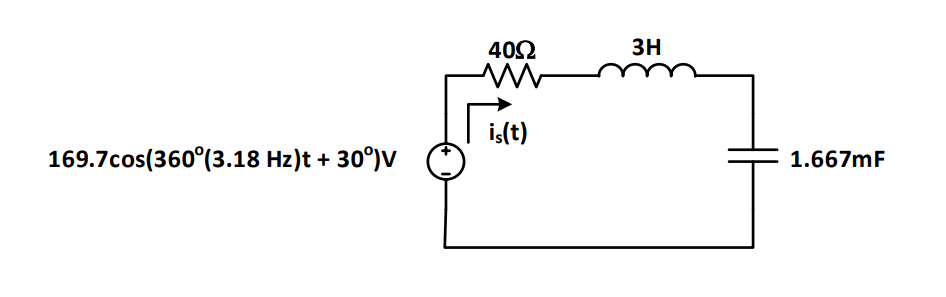
For the circuit below, find \(v_{0}(t)\) and \(i(t)\).
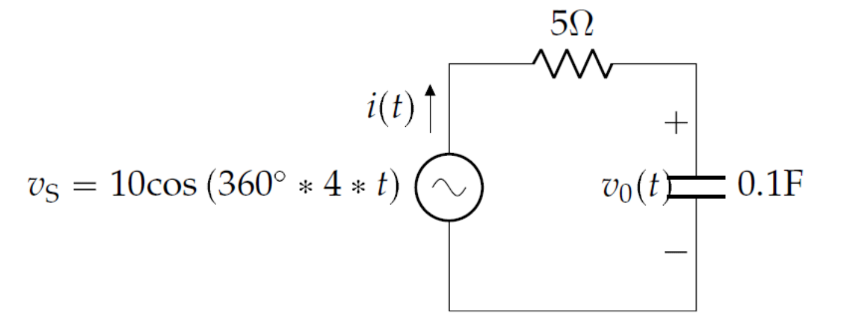
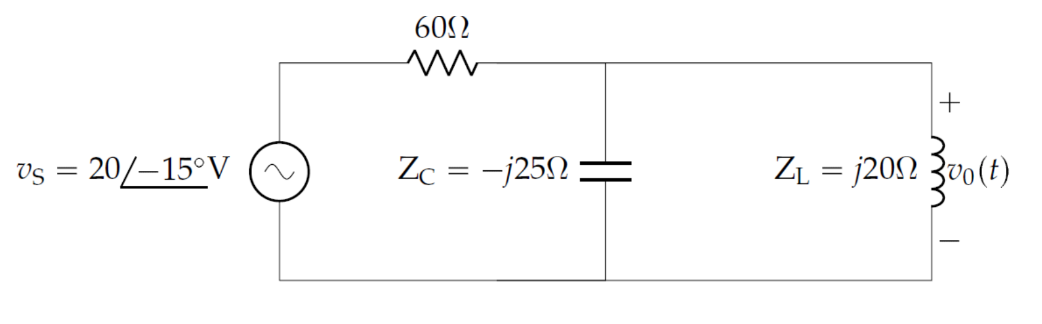
For the circuit below, find \(\widetilde{V_{o}}\) and the current flowing through the capacitor.