
Practice Problems (KEY)#
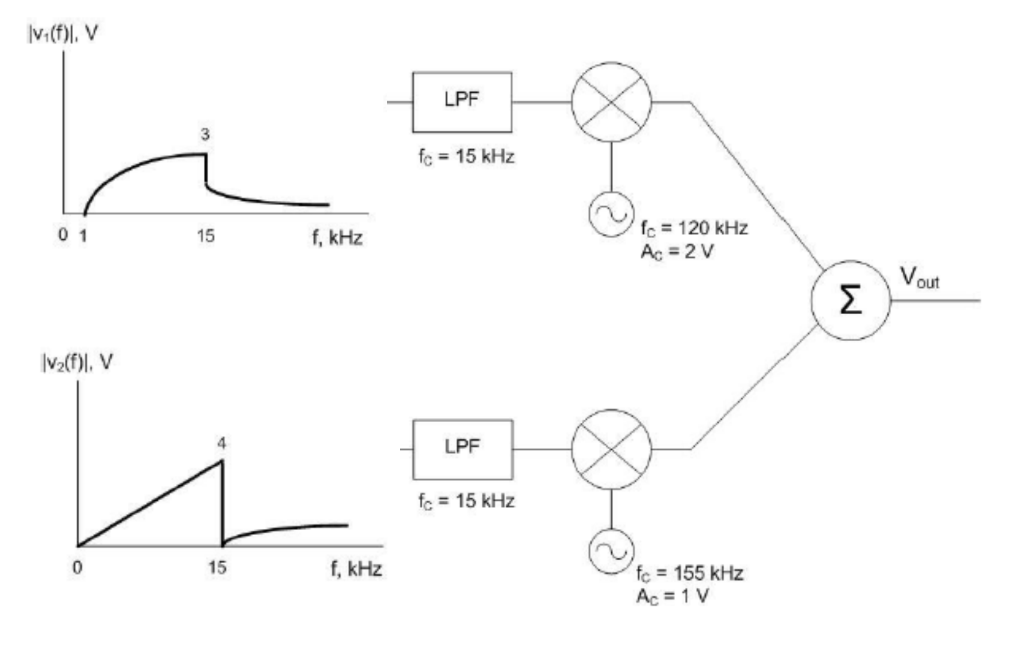
Graph the output of this FDM system in the frequency domain. Find the bandwidth of the modulated signal.
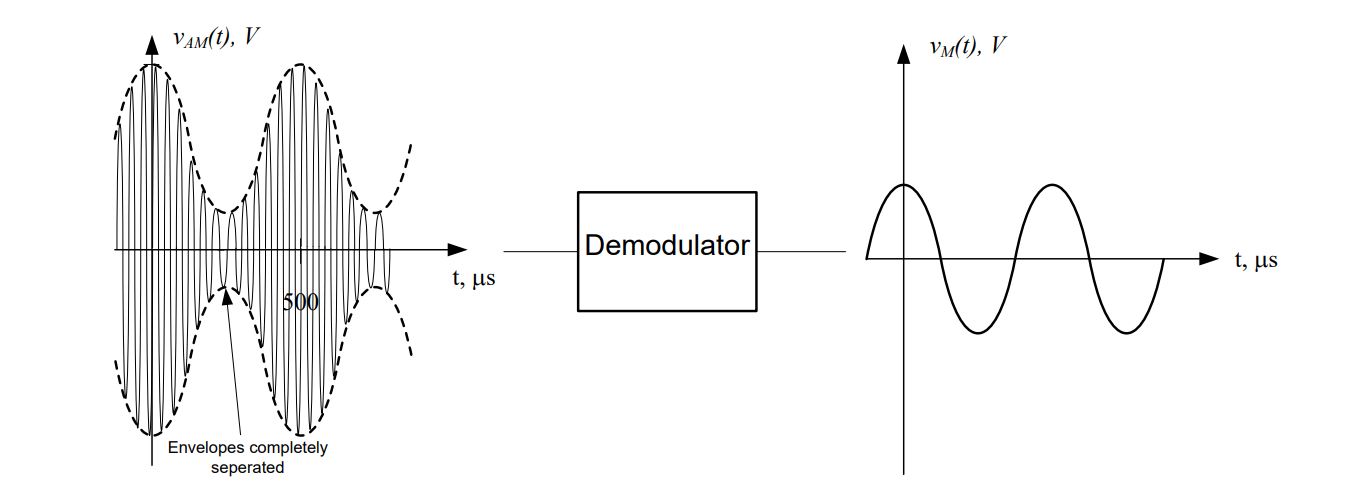
For an AM modulator, how does changing the amplitude of the bias affect the output waveform and the output amplitude spectrum?
If the signal is over-modulated, the bias is less than the amplitude of the message and the two envelopes overlap. As more bias is added, the envelopes are pulled apart.
At 100% modulation and for under-modulated signals, where the bias is greater than or equal to the amplitude of the message, the envelopes do not overlap.
Whenever bias is present, there is a spike at the carrier frequency. The height of this spike is directly proportional to the bias voltage.
Given the following message and carrier signals,
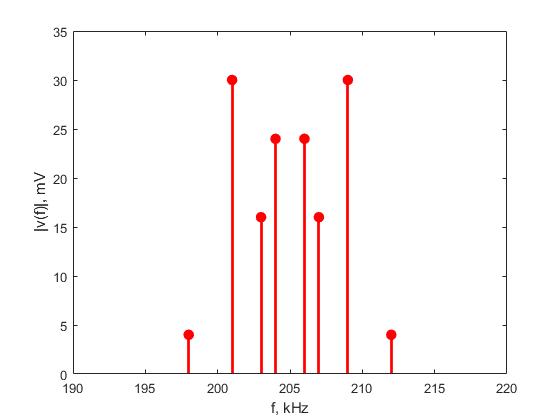
Given the following message and carrier signals, graph the output in the frequency domain:
Using the cosine identity and unit consistency:
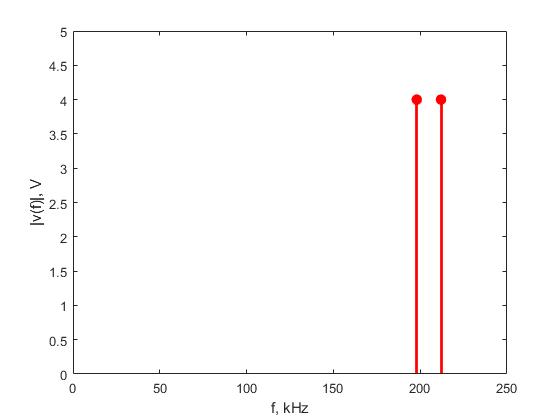
Given the following spectra, what is the equation for \(v_{out}(t)\)?
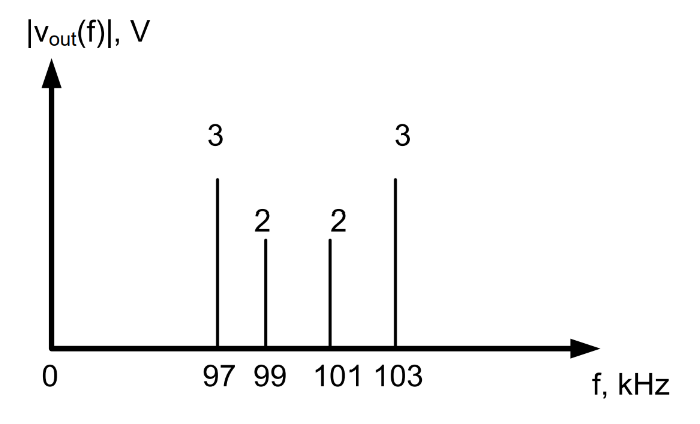
Each spectral line corresponds to a sinusoid.
Why do we add low-pass filters to an FDM system? How do we select the cutoff frequencies?
LPFs ensure signals do not contain frequencies that would overlap with other channels.
Cutoff frequency is set to the highest desired frequency of the input signal.
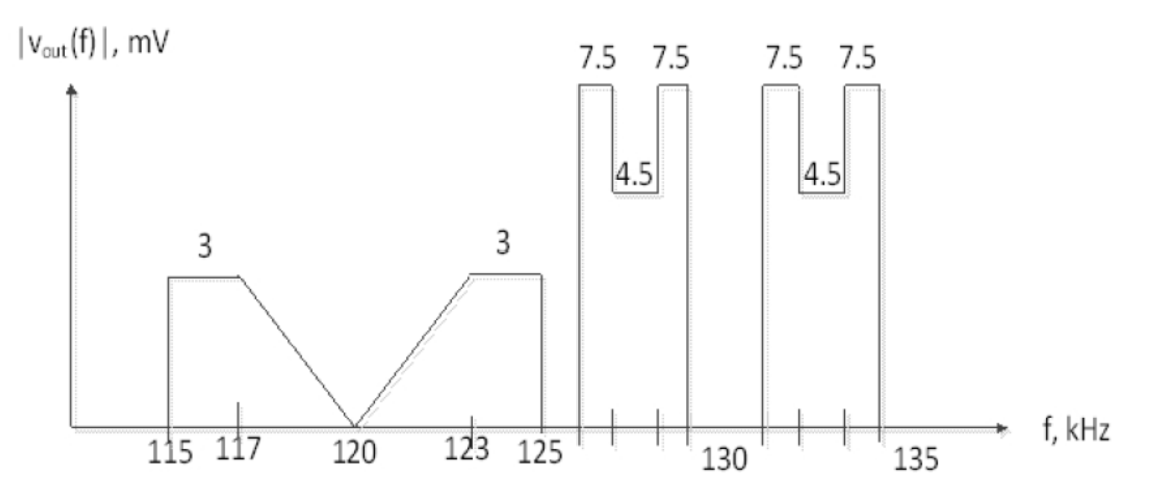
Graph the output of the multiplexer in the frequency domain. What is the bandwidth of \(v_{out}\)?
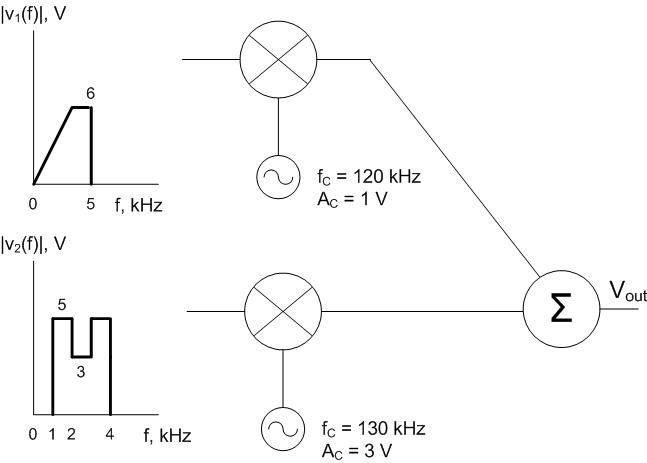
This problem can be difficult if you focus on the shapes. Instead, interpret the signal as the sum of many individual sinusoids at discrete frequencies.
Because the system is linear, superposition applies, so each sinusoid can be analyzed independently.
For a mixer with sinusoidal inputs, the output consists of the sum and difference of the frequency components. The sum term retains the shape of the input signal with appropriate magnitude scaling, while the difference terms appear as mirror images.
These components are shown below.
Using sum and difference properties:
T / F. Modulation allows us to transmit more than one signal over a single communications channel.
True
Yes, this is the purpose of modulation. While message signals may have similar frequency content (e.g., music), different radio stations use modulation to transmit signals through the air (the communication channel).
Because each transmission is assigned a different frequency, the signals do not interfere with one another.
In a modulated signal, how does bandwidth relate to the message?
Why is “changing the frequency of the bias” a nonsense question?
Bias is DC:
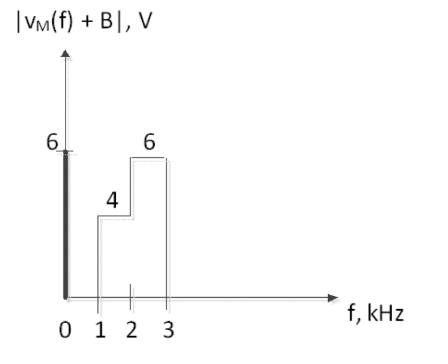
A message signal is input into an AM modulator as shown.
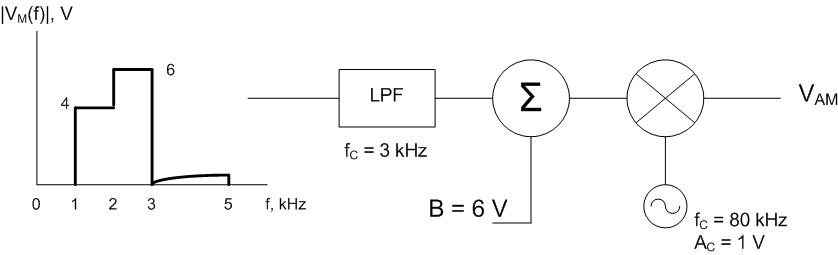
a. Message spectrum after bias:
Original spectrum unchanged
Add spike at \(f = 0\)
b. Output spectrum:
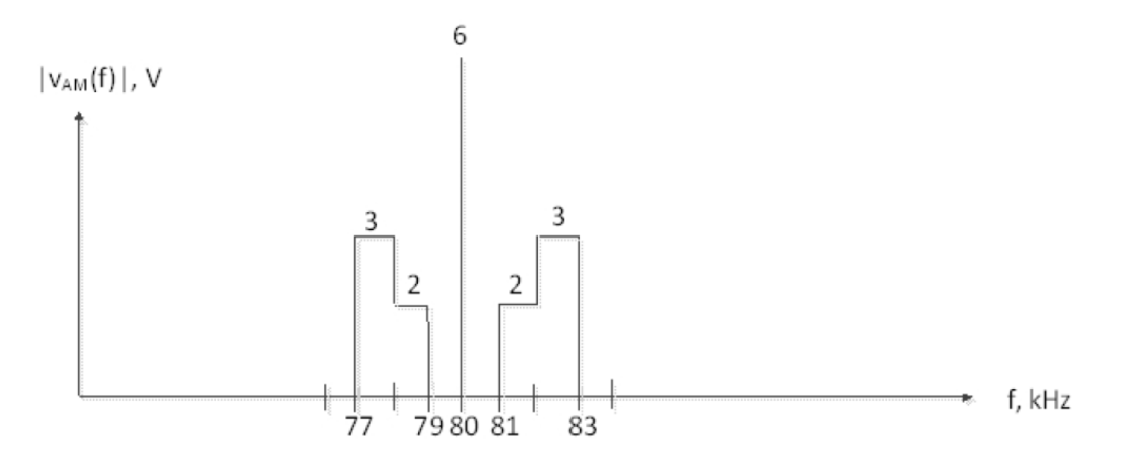
c. Bandwidth: