
Practice Problems (KEY)#
Problem 1.#
Calculate the cutoff frequency for a circuit with:
a. \(R = 1\ \text{k}\Omega\) and \(C = 3\ \text{nF}\)
Start with:
Substitute values:
Compute:
\(RC = (1000)(3\times10^{-9}) = 3\times10^{-6}\)
\(2\pi RC = 2\pi(3\times10^{-6}) \approx 1.884\times10^{-5}\)
So:
b. \(R = 5\ \text{k}\Omega\) and \(C = 1.5\ \mu\text{F}\)
Start with:
Substitute values:
Compute:
\(RC = (5000)(1.5\times10^{-6}) = 7.5\times10^{-3}\)
\(2\pi RC = 2\pi(7.5\times10^{-3}) \approx 4.712\times10^{-2}\)
So:
Problem 2.#
What should the resistor value be for the following filters:
a. \(f_{cutoff} = 1.5\ \text{kHz}\) and \(C = 500\ \text{nF}\)
Compute:
\(fC = (1500)(500\times10^{-9}) = 7.5\times10^{-4}\)
\(2\pi fC \approx 2\pi(7.5\times10^{-4}) \approx 4.712\times10^{-3}\)
So:
b. \(f_{cutoff} = 417\ \text{Hz}\) and \(C = 56\ \text{nF}\)
Compute:
\(fC = (417)(56\times10^{-9}) = 2.3352\times10^{-5}\)
\(2\pi fC \approx 2\pi(2.3352\times10^{-5}) \approx 1.467\times10^{-4}\)
So:
c. \(f_{cutoff} = 2\ \text{kHz}\) and \(C = 500\ \mu\text{F}\)
Compute:
\(fC = (2000)(500\times10^{-6}) = 1000\times10^{-3} = 1\)
\(2\pi fC = 2\pi(1)=2\pi\)
So:
Problem 3.#
Are the circuits below high or low pass filters? How do you know?
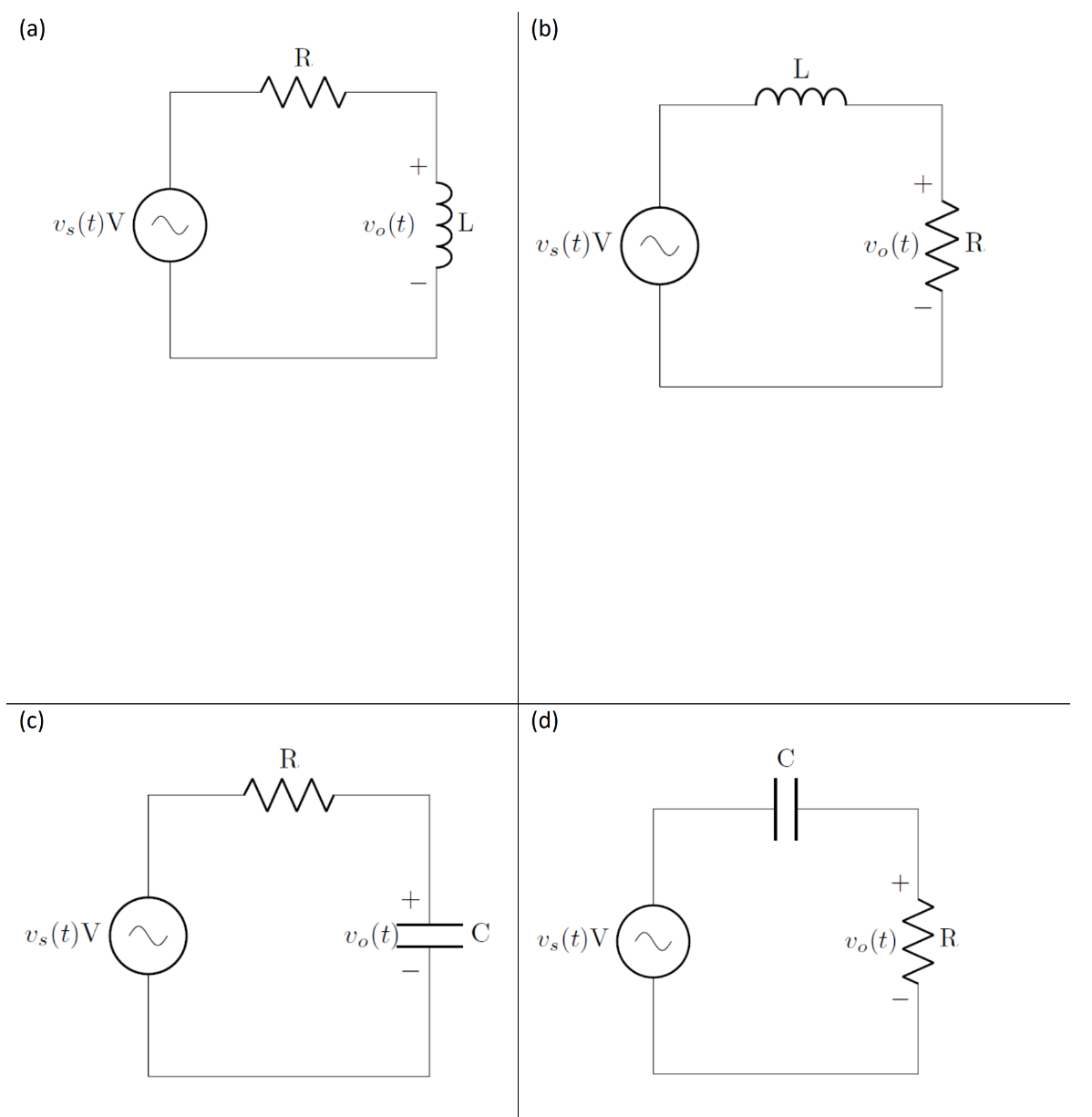
Key idea#
Evaluate the transfer function at:
\(f=0\) (DC / very low frequency)
\(f\rightarrow\infty\) (very high frequency)
If gain is near 1 at low frequency and near 0 at high frequency → LPF.
If gain is near 0 at low frequency and near 1 at high frequency → HPF.
3(a)#
Given:
:contentReference[oaicite:14]{index=14}
At \(f=0\): the term \(\frac{R}{j2\pi f L}\rightarrow\infty\), so denominator \(\rightarrow\infty\):
At \(f\rightarrow\infty\): the term \(\frac{R}{j2\pi f L}\rightarrow 0\), so denominator \(\rightarrow 1\):
Conclusion: High Pass Filter (HPF).
3(b)#
Given:
:contentReference[oaicite:16]{index=16}
At \(f=0\):
At \(f\rightarrow\infty\): \(j2\pi f L\) dominates, so magnitude grows large and:
Conclusion: Low Pass Filter (LPF).
3(c)#
Given:
At \(f=0\):
At \(f\rightarrow\infty\): \(j2\pi fCR\) dominates, so:
Conclusion: Low Pass Filter (LPF).
3(d)#
Given:
At \(f=0\): the term \(\frac{1}{j2\pi fRC}\rightarrow\infty\), so denominator \(\rightarrow\infty\):
At \(f\rightarrow\infty\): the term \(\frac{1}{j2\pi fRC}\rightarrow 0\), so denominator \(\rightarrow 1\):
Conclusion: High Pass Filter (HPF).
Problem 4.#
Calculate the cutoff frequency of the following systems.
a. A transmission line modeled as an R-L circuit with \(R = 4\ \Omega\) and \(L = 5\ \mu\text{H}\).
Use:
Substitute:
Compute:
\(2\pi L = 2\pi(5\times10^{-6}) \approx 3.1416\times10^{-5}\)
So:
b. An R-C low pass filter with \(R = 60\ \Omega\) and \(C = 5\ \text{nF}\).
Compute:
\(RC=(60)(5\times10^{-9})=3\times10^{-7}\)
\(2\pi RC \approx 2\pi(3\times10^{-7}) \approx 1.885\times10^{-6}\)
So:
c. A C-R high pass filter with \(R = 100\ \Omega\) and \(C = 8\ \mu\text{F}\).
Compute:
\(RC=(100)(8\times10^{-6})=8\times10^{-4}\)
\(2\pi RC \approx 2\pi(8\times10^{-4}) \approx 5.027\times10^{-3}\)
So:
Problem 5.#
Your communications radio has a lower frequency bound of \(800\ \text{kHz}\). You know it has a capacitor value of \(100\ \text{nF}\), but what is the resistor value?
Rearrange:
Substitute:
Compute:
\(fC=(800000)(100\times10^{-9})=0.08\)
\(2\pi fC = 2\pi(0.08)\approx 0.50265\)
So:
Problem 6.#
Design a high pass filter to get rid of a DC bias (\(0\ \text{Hz}\)) using a \(100\ \Omega\) resistor you have available.
DC bias corresponds to \(f=0\) Hz, so we choose a practical cutoff (given): \(f_{cutoff}=10\) Hz.
Use:
Solve for \(C\):
Substitute:
Compute:
\(2\pi(10)(100)=2000\pi\approx 6283.19\)
So:
Problem 7.#
For the circuit below, what is the magnitude of the gain, \(\left|\frac{v_{o}}{v_{in}}\right|\), at \(60\ \text{Hz}\)?
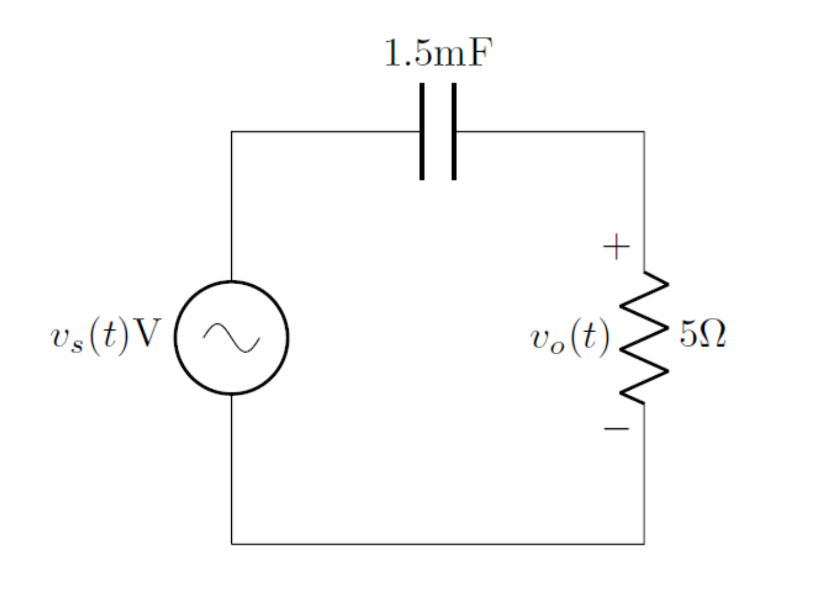
Given transfer function:
Substitute the provided values (as shown in the key):
The evaluated complex result is:
Magnitude is:
Interpretation:
The filter passes \(94.2\%\) of the input at 60 Hz, so 60 Hz is in the passband.