Practice Problems (KEY)
Problem 1
(a) Find \(I_S\):
\[R_{\text{eq}} = R_1 + \left(\frac{1}{R_2} + \frac{1}{R_3 + R_4 + R_5}\right)^{-1} + R_6 = 8.71\,\Omega\]
\[I_S = \frac{V_S}{R_{\text{eq}}} = \frac{5\,\text{V}}{8.71\,\Omega} = \boxed{574\,\text{mA}}\]
(b) Find the power consumed by \(R_2\) (current divider):
\[I_2 = I_S \frac{R_{2,3,4,5}}{R_2} = (574\,\text{mA})\frac{1.714\,\Omega}{2\,\Omega} = 492\,\text{mA}\]
\[P_2 = I_2^2 R_2 = (0.492\,\text{A})^2(2\,\Omega) = \boxed{484\,\text{mW}}\]
Verification using voltage divider:
\[V_2 = V_S \frac{R_{2,3,4,5}}{R_{\text{eq}}} = (5\,\text{V})\frac{1.714\,\Omega}{8.714\,\Omega} = 984\,\text{mV}\]
\[P_2 = \frac{V_2^2}{R_2} = \frac{(0.984\,\text{V})^2}{2\,\Omega} = 484\,\text{mW} \checkmark\]
Problem 2
\[R_{\text{eq}} = R_1 + R_{2,3} = 50\,\Omega + \left(\frac{1}{500\,\Omega} + \frac{1}{500\,\Omega}\right)^{-1} = \boxed{300\,\Omega}\]
\[I_S = \frac{V_S}{R_{\text{eq}}} = \frac{1.5\,\text{V}}{300\,\Omega} = \boxed{5\,\text{mA}}\]
\[P_{\text{Total}} = I_S V_S = (5\,\text{mA})(1.5\,\text{V}) = \boxed{7.5\,\text{mW}}\]
\[I_2 = \frac{R_{2,3}}{R_2} I_S = \frac{250\,\Omega}{500\,\Omega}(5\,\text{mA}) = 2.5\,\text{mA}\]
\[P_2 = I_2^2 R_2 = (2.5\,\text{mA})^2(500\,\Omega) = \boxed{3.125\,\text{mW}}\]
Problem 3
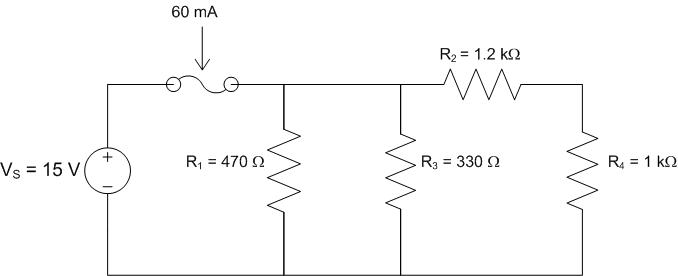
\[R_{\text{EQ}} = \left(\frac{1}{470\,\Omega} + \frac{1}{330\,\Omega} + \frac{1}{1.2\,\text{k}\Omega + 1\,\text{k}\Omega}\right)^{-1} = 178.17\,\Omega\]
\[I_S = \frac{V_S}{R_{\text{EQ}}} = \frac{15\,\text{V}}{178.17\,\Omega} = 84.19\,\text{mA}\]
No, the fuse rating is not high enough: \(84.19\,\text{mA} > 60\,\text{mA}\) — the fuse will pop.
The fuse should be rated between:
\[I_{\text{fuse,min}} = 1.1 \times 84.19\,\text{mA} = 92.6\,\text{mA}\]
\[I_{\text{fuse,max}} = 1.5 \times 84.19\,\text{mA} = 126.3\,\text{mA}\]
Choose a 100 mA fuse from the parts bin.
Problem 4
\[V_{\text{Adapter}} = V_S - V_{\text{Lamp}} = 115\,\text{V} - 45\,\text{V} = 70\,\text{V}\]
\[R_{\text{Adapter}} = \frac{V_{\text{Adapter}}}{I_S} = \frac{70\,\text{V}}{2\,\text{A}} = \boxed{35\,\Omega}\]
Problem 5
Answer: (a) True
In a series circuit the same current \(I\) flows through every resistor. By Ohm’s Law, \(V = IR\), so a larger resistance produces a larger voltage drop.
Problem 6
Answer: (b) False
In a series circuit there is only one path for current. By KCL, the same current flows through every element regardless of its resistance value.
Problem 7
Answer: (a) True
Parallel resistors share the same voltage. By \(I = V/R\), a smaller resistance draws more current — this is the defining property of the current divider.
Problem 8
Answer: (a) True
Each additional parallel path provides another route for current, reducing total resistance. The parallel combination \(R_{\text{eq}} = \left(\sum 1/R_i\right)^{-1}\) is always less than the smallest individual resistor.
Problem 9
Answer: (b), (c), (d)
(a) False — A fuse does not prevent normal operation.
(b) True — A properly sized fuse carries the normal operating current without blowing.
(c) True — By breaking the circuit before current becomes dangerously high, a fuse protects the wiring from overheating.
(d) True — A fuse opens (melts) when current exceeds its rated value, interrupting the circuit.
Problem 10
a. Circuit #1 — Find \(V_x\)
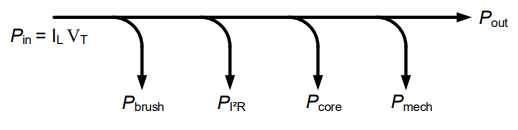
Three resistors (\(6\,\Omega\), \(2\,\Omega\), \(4\,\Omega\)) are in series; \(V_x\) is across the \(2\,\Omega\) resistor.
\[R_{\text{eq}} = 6\,\Omega + 2\,\Omega + 4\,\Omega = 12\,\Omega\]
\[I_S = \frac{V_S}{R_{\text{eq}}} = \frac{72\,\text{V}}{12\,\Omega} = 6\,\text{A}\]
\[V_x = I_S \times 2\,\Omega = 6\,\text{A} \times 2\,\Omega = \boxed{12\,\text{V}}\]
b. Circuit #2 — Find \(i_z\)
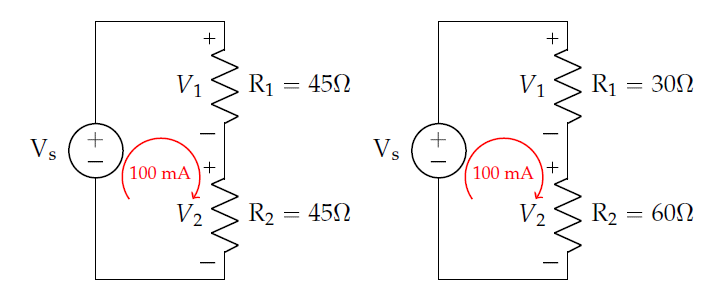
The \(12\,\Omega\) and \(8\,\Omega\) resistors are in parallel across the \(18\,\text{V}\) source; \(i_z\) flows through the \(12\,\Omega\) resistor.
Since the full source voltage appears across each parallel branch:
\[i_z = \frac{V_S}{12\,\Omega} = \frac{18\,\text{V}}{12\,\Omega} = \boxed{1.5\,\text{A}}\]
Problem 11
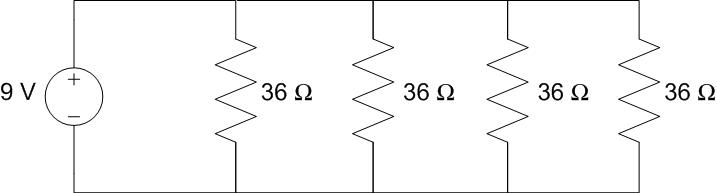
Four identical \(36\,\Omega\) bulbs in parallel:
\[R_{\text{eq}} = \frac{36\,\Omega}{4} = 9\,\Omega\]
\[P = \frac{V_S^2}{R_{\text{eq}}} = \frac{(9\,\text{V})^2}{9\,\Omega} = \boxed{9\,\text{W}}\]
Problem 12
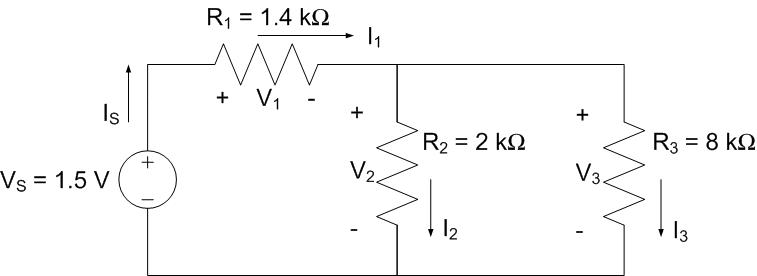
The SATCOM circuit has \(R_1\) in series with the source; \(R_2\) and \(R_3\) form a parallel branch (\(R_2 < R_3\)).
(a) \(I_1 = I_2\): False — \(I_1\) is the total source current; \(I_2\) is only the fraction through \(R_2\).
(b) \(V_2 = V_3\): True — \(R_2\) and \(R_3\) are in parallel, so they share the same voltage.
(c) \(I_2 > I_3\): True — Smaller resistance (\(R_2 < R_3\)) draws more current in a current divider.
(d) \(V_1 + V_3 = V_S\): True — KVL around the outer loop: \(V_S = V_{R_1} + V_{R_2\|\|R_3} = V_1 + V_3\).
Answer: (b), (c), (d)
Problem 13
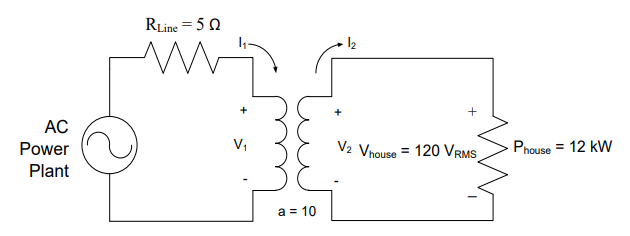
\(R_1 = 600\,\Omega\), \(R_2 = 300\,\Omega\), \(R_3 = 400\,\Omega\), \(R_4 = 500\,\Omega\), \(I_4 = 200\,\text{mA}\)
Topology: \(V_S \to R_1 \to\) Node A. From Node A: \(R_3\) to ground (shunt) and \(R_2 \to R_4\) to ground (series right branch, carrying \(I_4\)).
(a) \(R_{\text{eq}}\) as seen by \(V_S\):
Step 1 — Combine the right branch (\(R_2\) and \(R_4\) in series):
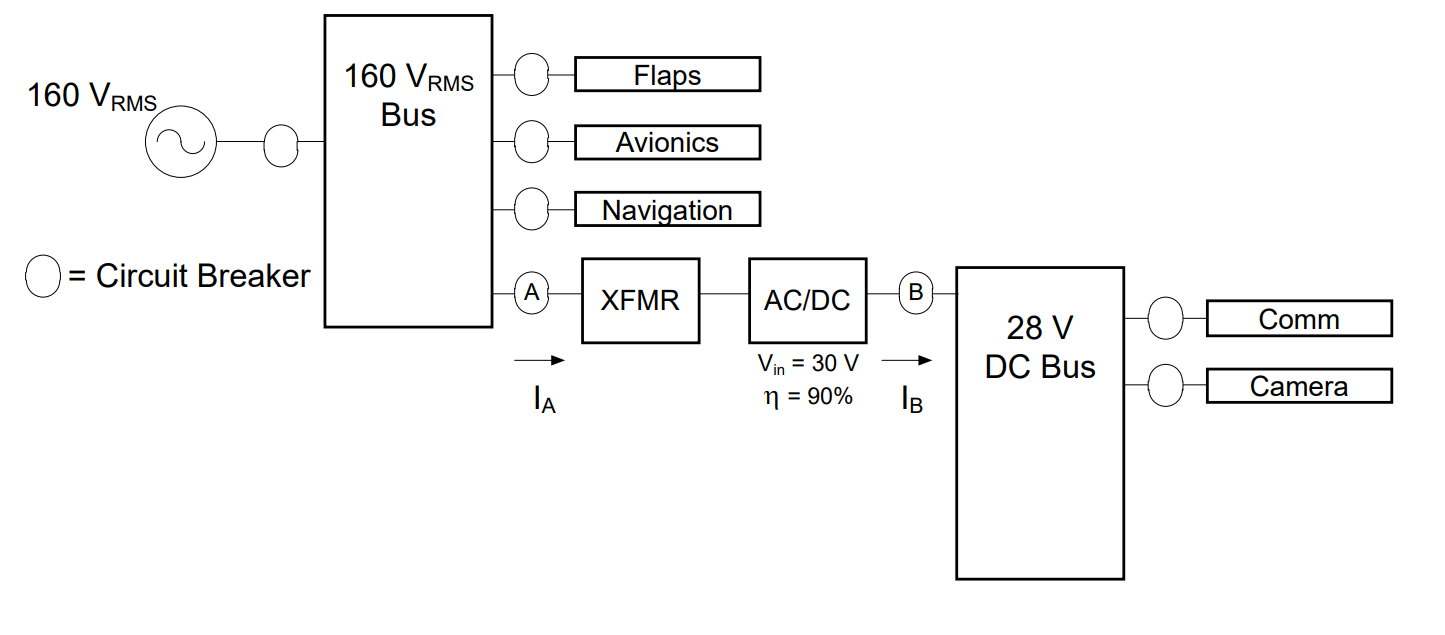
\[R_{\text{eq},1} = R_2 + R_4 = 300\,\Omega + 500\,\Omega = 800\,\Omega\]
Step 2 — Combine \(R_{\text{eq},1}\) with \(R_3\) in parallel:

\[R_{\text{eq},2} = R_{\text{eq},1} \| R_3 = \frac{800\,\Omega \times 400\,\Omega}{800\,\Omega + 400\,\Omega} = \frac{320{,}000}{1{,}200} = 266.7\,\Omega\]
Step 3 — Add \(R_1\) in series:
\[R_{\text{eq}} = R_1 + R_{\text{eq},2} = 600\,\Omega + 266.7\,\Omega = \boxed{866.7\,\Omega}\]
(b) Source voltage \(V_S\):
The voltage at Node A equals the voltage across the right branch:
\[V_A = I_4 \times R_{\text{eq},1} = (200\,\text{mA})(800\,\Omega) = 160\,\text{V}\]
Current through \(R_3\) (shunt):
\[I_3 = \frac{V_A}{R_3} = \frac{160\,\text{V}}{400\,\Omega} = 400\,\text{mA}\]
Total source current (KCL at Node A):
\[I_S = I_3 + I_4 = 400\,\text{mA} + 200\,\text{mA} = 600\,\text{mA}\]
\[V_S = I_S \times R_{\text{eq}} = (600\,\text{mA})(866.7\,\Omega) = \boxed{520\,\text{V}}\]
(c) Power dissipated in \(R_2\):
\(R_2\) and \(R_4\) are in series, so \(I_2 = I_4 = 200\,\text{mA}\):
\[P_2 = I_2^2 R_2 = (0.200\,\text{A})^2(300\,\Omega) = \boxed{12\,\text{W}}\]
(d) Voltage across \(R_4\):
\[V_4 = I_4 \times R_4 = (200\,\text{mA})(500\,\Omega) = \boxed{100\,\text{V}}\]
Problem 14
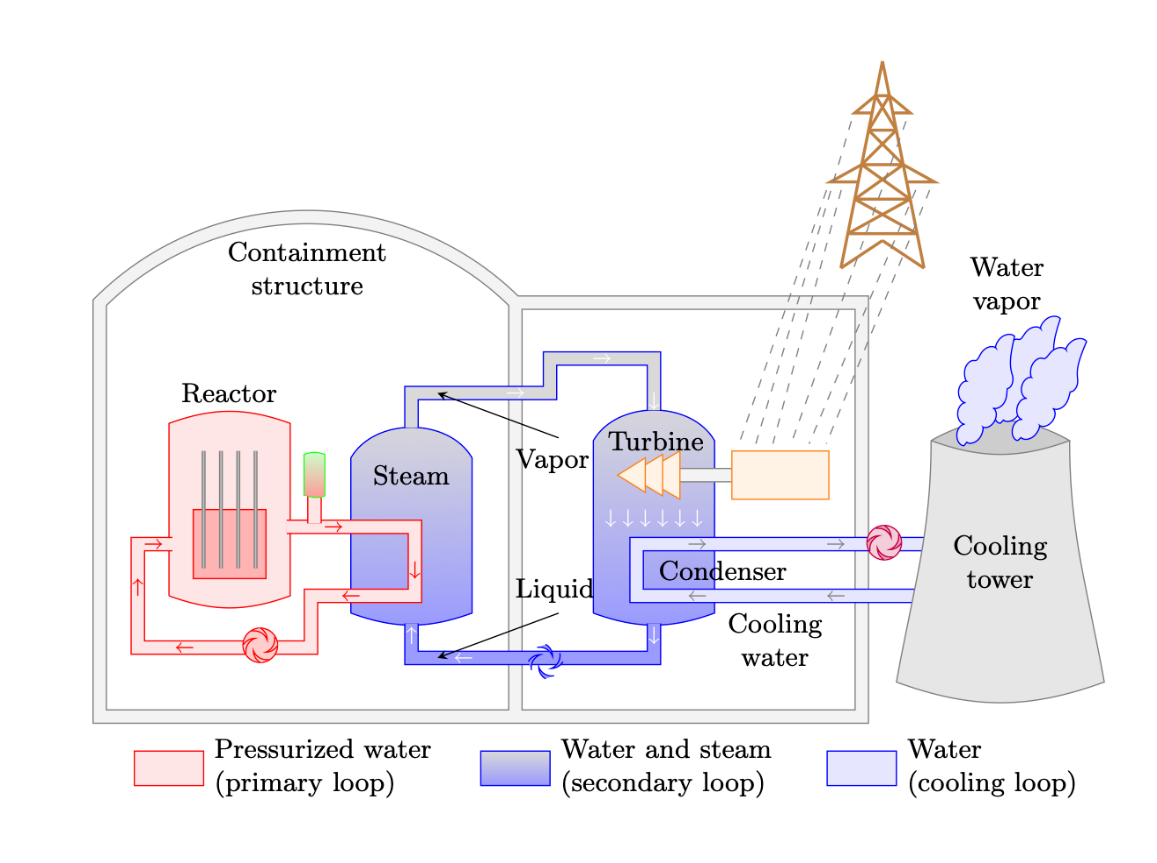
Three \(3\,\Omega\) bulbs in series; fuse rated at \(5\,\text{A}\).
(a) Maximum supply voltage before the fuse blows:
\[R_{\text{eq}} = 3 \times 3\,\Omega = 9\,\Omega\]
\[V_{\max} = I_{\text{fuse}} \times R_{\text{eq}} = 5\,\text{A} \times 9\,\Omega = \boxed{45\,\text{V}}\]
(b) Voltage across each bulb at maximum current:
\[V_{\text{bulb}} = I_{\text{fuse}} \times R_{\text{bulb}} = 5\,\text{A} \times 3\,\Omega = \boxed{15\,\text{V}}\]
Problem 15
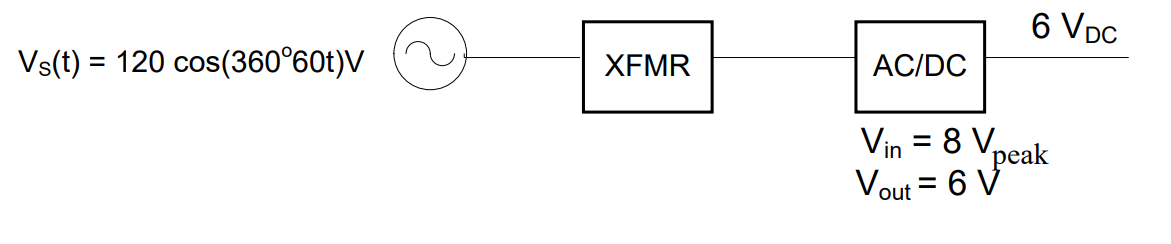
\(V_S = 120\,\text{V}\), \(R_{\text{TV}} = 5\,\text{k}\Omega\), \(V_{\text{TV}} = 50\,\text{V}\) required.
Find the required adapter resistance:
\[V_{\text{adapter}} = V_S - V_{\text{TV}} = 120\,\text{V} - 50\,\text{V} = 70\,\text{V}\]
\[I_S = \frac{V_{\text{TV}}}{R_{\text{TV}}} = \frac{50\,\text{V}}{5\,\text{k}\Omega} = 10\,\text{mA}\]
\[R_{\text{adapter}} = \frac{V_{\text{adapter}}}{I_S} = \frac{70\,\text{V}}{10\,\text{mA}} = 7\,\text{k}\Omega\]
(a) Using \(2\,\text{k}\Omega\) and \(3\,\text{k}\Omega\) resistors:
\[2\,\text{k}\Omega + 2\,\text{k}\Omega + 3\,\text{k}\Omega = \boxed{7\,\text{k}\Omega}\ \checkmark\]
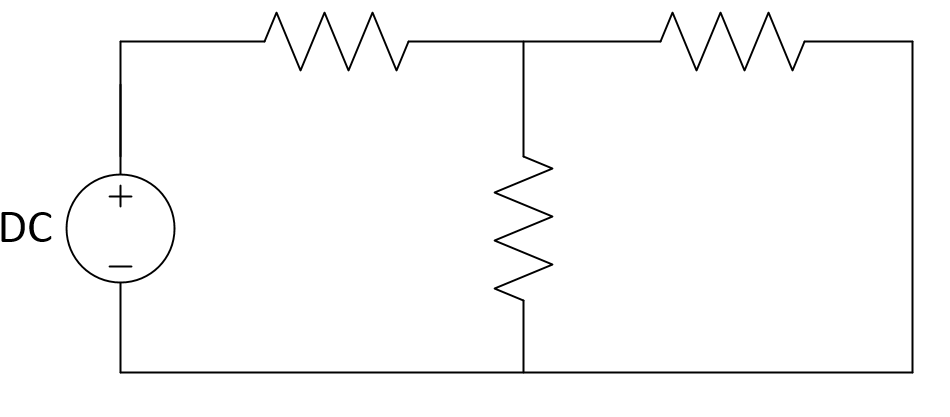
(b) Using only \(2\,\text{k}\Omega\) resistors:
Place two \(2\,\text{k}\Omega\) resistors in parallel to create \(1\,\text{k}\Omega\), then connect three more \(2\,\text{k}\Omega\) resistors in series with that combination:
\[(2\,\text{k}\Omega \| 2\,\text{k}\Omega) + 2\,\text{k}\Omega + 2\,\text{k}\Omega + 2\,\text{k}\Omega = 1\,\text{k}\Omega + 6\,\text{k}\Omega = \boxed{7\,\text{k}\Omega}\ \checkmark\]